Certificates · Culturalism · Federal Government

The Illusion of Resistance

Much clucking and chirping is afoot in the GOP Twittersphere over surprisingly good House election outcomes for the 2020 election. Republicans won a handful of seats, and may end up forcing the Dems as low as 220 representatives, a weak majority over next year’s Congress. Though this might seem exciting to politicos and their ilk, the result simply outlines yet again the haplessness of belief in resistance-style politics championed by both the Right and Left.

If we cycle back to 2010, the conservative party used Tea Party anger against Obamacare and “wasteful spending” to power its 63-seat swing against Democrats, leading to a majority of 242. They fell short in the Senate, but nevertheless gained seats. Now, did America see historic cuts or entitlement reform? Absolutely not, because GOP resistance amounted to simply opposing tax increases on the wealthy, whilst blocking serious spending reductions at every turn. Such bumbling proceeded on to the 2012 presidential election, which rewarded the dedicated TP activists with a campaign platform sworn to protect Mitt Romney from tax penalties and back a budget plan with net cuts of only $155 billion. Why? Because the Tea Party quickly became a subsidiary of Koch Brothers interests, not the average American.

In late 2011, Occupy Wall Street protests exploded across the country, determined to draw attention to corporate greed. Despite their fierce tenacity, and the relative pro-corporate leanings of Barack Obama, the protestors ultimately ended up serving as a political and financial cow to help Democrats retain the presidency. The people insistent on getting money out of politics helped return a figure who raised more from Wall Street corporations than his “pro-business” Republican opponent.  Once more, an allegedly populist movement got co-opted by the financial mainstream, and with scarcely a cry issued.

More recently, the Black Lives Matter riots have shown a similar nature. Although presuming to oppose a tyrannical police state praying on minorities, the street advocates and their “La Resistance” friends have no conflict with blindly obeying the dictums of CDC officials to “mask up,” or translating their movement into a train of endorsement for Biden, perhaps the vilest plutocrat to attain office in short memory. The very idea that committed protestors happily obey the medical industry complex as they pretend to stand for justice, or submissively quiet down to help a Democrat attain power; said actions demonstrate a brilliant lack of autonomy and agency which undercut the primary themes. Nothing is really being disrupted, only the comfort of political opponents.

So it’s all well and good that Republicans are excited about their prospects, but these remain meaningless without action. Until legislation is on the desk—signed—their fist-waving and proclamations about being “loyal opposition”  will stay as mere words. For opposition is futile, and resistance an illusion.

Federal Government · investing

Can Bitcoin Be Regulated?

One of the great cultural nuances of the internet is how everyone can be right. Providing you are convincing, or at least look the part, most effective dissent will get chucked out the window, along with any need for respect. In point, we have the prototypical messaging of the Bitcoin-promoting community, which often argues that digital currency is beyond government regulation or control due to algorithms and encryption. They have some credibility, but as with all things deemed to “beat the system,” there are major exceptions which must be considered.

To start, the idea that crypto transactions can simply fly under the radar is muddled by known IRS actions. The federal government has already issued warnings to thousands of people about failure to report crypto gains to the IRS, and significant penalties lurk for those who flaunt such warnings. We also have the recent indictment of John McAfee for allegedly hiding cryptocurrency assets. Thus from a reactive standpoint the State is already gearing up for the long haul fight.

Perhaps more immediately, reports suggest the government seized around $1 billion worth of Bitcoin connected to the controversial Silk Road marketplace, whose founder Ross Ulbricht was given a life sentence for numerous alleged crimes. That’s a small but noticeable chunk of the overall coin value, and it’s not the first time Uncle Sam has held a stake. Other governments such as Bulgaria have snapped up digital currency in the past, with the leaders in Sofia holding 200,000 bitcoins at one stage.

Ruling out these sorts of criminal situations, what of the more obvious methods for centralized regulation? Governments could begin requiring trading firms like Coinbase to meet specific standards of licensure and tax reporting, much as investment companies are required to do. They might also go after crypto miners, placing restrictions or taxes on their Morian mainframes These are hardly out of the question when we examine the history of the State, and its insatiable desire for money.

By this I don’t mean to suggest crypto is a bad idea; in fact, I own a great deal and will continue adding. Just avoid becoming too drunk on the swill of lolbertarianism. As Ronny boy might say, “The government wants what it wants.”

Culturalism · Federal Government

How Conservatives Protest

Last week at the MAGA rally, Sebastian Gorka spoke by the Supreme Court, loudly demanding to the Plural Left, “Where’s all the looting and burning?” Much applause followed, and conservatives proudly reminded themselves how much better they were than their liberal opponents. After further marching and cheering, they all went home.

Gorka’s comment and the behavior it refers to are important because they help encapsulate the very heart of conservative attitudes towards resistance or civil disobedience. Over the summer, the Right continued spinning narratives about how they supported “law and order” versus the historically butthurt and rich leftist protestors who milled about, smashing businesses and looting stores. The idea was that the “good guys” would defend small businesses and “Back the Blue,” while their enemies ran amuck to cause destruction.

Such a storyline works well so long as you maintain power, because it projects the Boomer idea of communities under assault by the wild and communistic. Once elections go the other way, however, the message is a completely dull edge. Peacefully protesting election officials or courts while maintaining support for the establishment (laws, police, military), effectively implies acquiescence to whatever outcome they are sworn to protect. “Law and Order” now means accepting a Bidenesque presidency, even if the tagline is that fraud has been perpetrated across the country.

Herein rests the heart of conservative struggles with any form of a civil standoff. Much as they might enjoy parading around with their gun collections and body armor wardrobes, the fact remains that any sort of outright defiance requires them to break their own political talking points on defense of public order. Doing battle with police or the military makes them “traitors,” or “unpatriotic,” so instead the approach involves softly declaring opposition and then disappearing off into a SuperBowl Sunday watch session.

For all those reasons, it is hard to imagine any significant conservative action to overturn balloting results. The courts so far have been rather timid, and individuals themselves remain caught in the same conflict of belief. Do the people defending tradition and “the way it has always been” take a risk and break their own vows?

Probably not.

Culturalism

What I Saw In DC

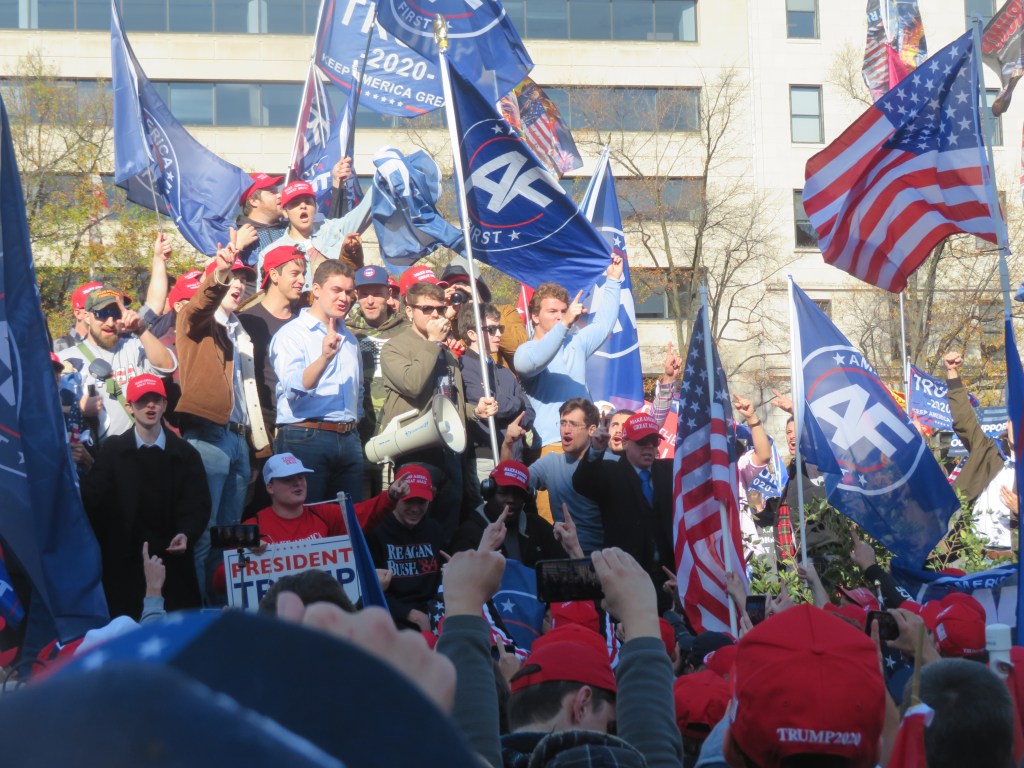
Thanks to a profoundly unGoldberg move today, in which I ventured up to Washington D.C. to check out the MAGA March, some observations must now be made. We’ll allow the pictures to tell a story:

Young People Are Nationalists

When Nick Fuentes began speaking, the more youthful crowd pretty much ignored establishment Republican speakers, who kept loling about courts and not being waycists. Ironically, lots of minorities were in the Fuentes crowd, despite what the media would suggest.

Westboroesque Trads Presented

Some lolbertarians began arguing with them, while others encouraged a policy of ignoring their language.

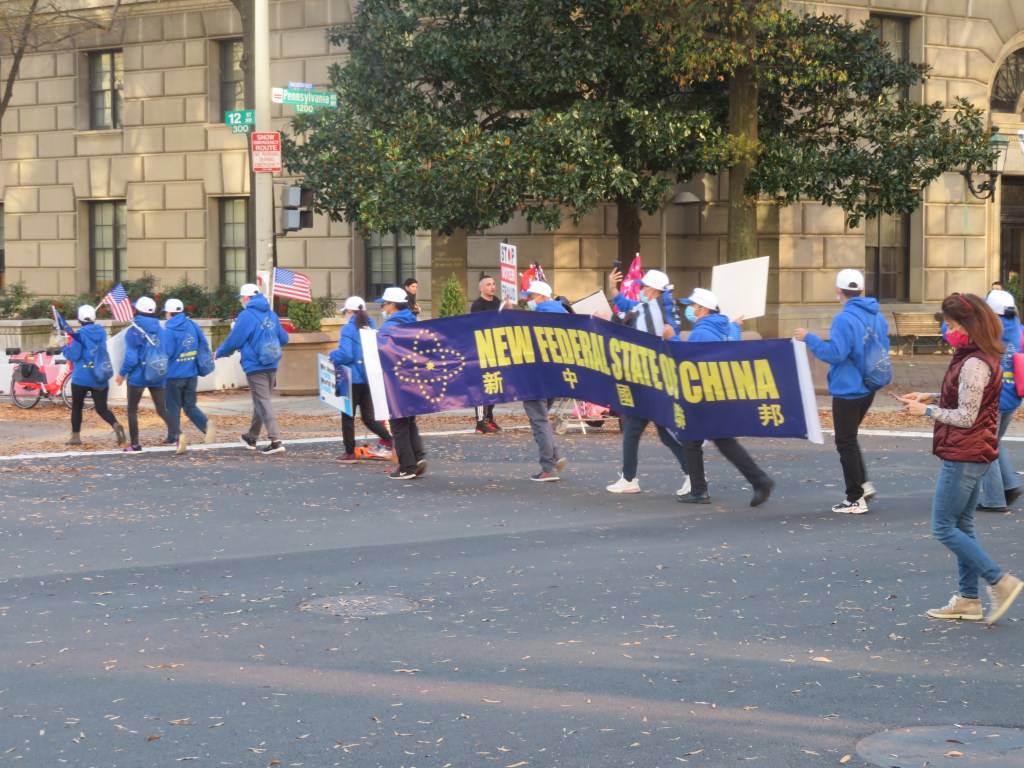
LOTS of Anti-CCP Protestors

This was a small part of a massive parade led by Chinese folks against the CCP. Taiwanese activists were there as well.

AntiFa Girls Love Sweatshop Companies

People Trust SCOTUS To Help Trump

Those Numbers Tho

Culturalism

Not So Subtle

At times I wonder if this is all too boring. The human mind gets constant bombardment with imagery and hidden meanings that it may fail to properly analyze, so perhaps the overt damage remains minimal. We can just go about our days, enjoying the loverly roses on the wayside, and pretend nothing is wrong. Because, to be fair, they’re hardly full frontal messages, only symbols.

Not quite. Symbolism may seem harmless, yet it has the capacity to influence us on a subconscious level, perhaps explaining why even the most rabid degenerates dismiss very real concepts as “conspiracy theories” without stopping to perform some basic introspection. The fact that they are literally swimming in the same debauchery being documented doesn’t matter, because no one is flat out telling them to wear a goat mask or make ritual sacrifices – and the media is ready to guard against any suggestion of the same.

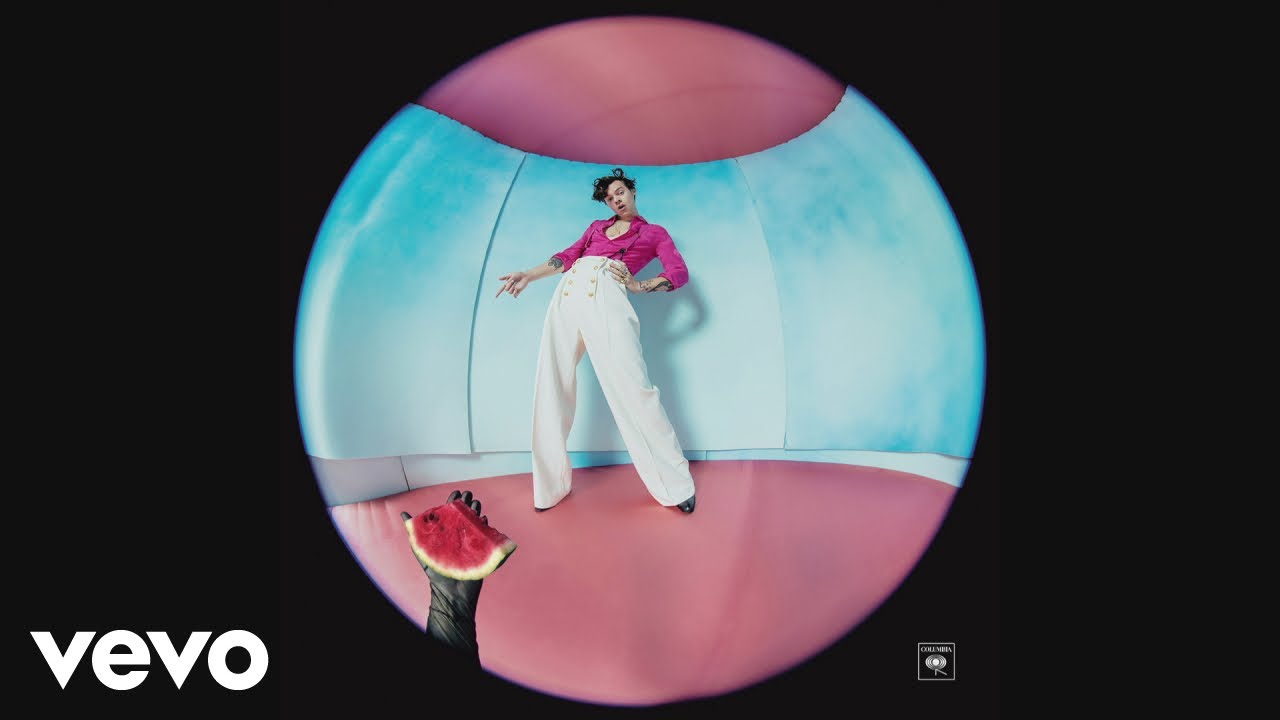
Look at the song “Watermelon Sugar” as a profile. In the (sorrowfully) G-rated interpretation, it references a classic form of street heroin native to Southern cities in the United States. So Harry Styles is promoting drug use…what’s the big deal?

Well, an alternative explanation suggests the song actually concerns a rather mundane sex act. Twitter is alight with typically millennial fixation over a topic of abject nothingness. Styles himself remains barely cagey about the notion:

Once more, a prominent and talented musician is incapable of creating work without observing loyal deference to the base instincts of human creatures. The still for his audio only version features imagery suggesting Styles may well be on the other side, and certainly in favor of BLM:

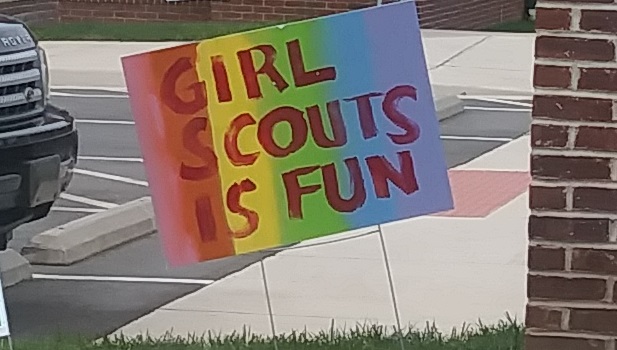
Sure, it’s only a song, but the hidden messaging can also be found closer to home. The other day I drove past a polling place with the following spectacle, jammed carefully between signs for the empowered Democratic nominees:

We already know the Girl Scouts long ago sold out to progressive causes, but is this sort of thing necessary? The rainbow background with its common political meaning, joined to the word FUN, reeks of a desire to groom children. Unsurprisingly, it has happened before. The laughably-renamed Scouts BSA is almost worse, requiring participants to complete ideological indoctrination programs a sane person would compare to the menacing practices of communist regimes.

Although I suppose they’re just symbols.   

Culturalism · Federal Government

Why Revolutions Fail

Ever since I knew enough to remember, there has been talk of revolutions around the world. Tea Party folks declared one would occur if Obama violated their freedoms, leftists did the same under Trump, Arabs bathed in the blanketed feel of their springs, and Hong Kong residents attempted to defeat their colonial government. Whether successful or not, these movements become a romanticized conception of life, a cause that for some seems worth more than all the cost.

Yet they seldom succeed. This isn’t to say political revolutions don’t occur; after all, there is only so much time corruption can stand before the pieces crumble. Instead, the preliminary forces which make such actions possible tend to fizzle out by the time people have gotten a taste of power – and the wealth accompanying it. The average activist doesn’t want to spend their entire life protesting or undermining the system because doing so might cause them to miss out on the niceties of each day. Much like intensely religious people often lapse into the vices of an enjoyable existence rather than remaining pious and stoic forever. The risk of missing out appears too great to ignore.

A book which outlines this dynamic brilliantly is Alexander II: The Last Great Tsar by Edvard Radzinsky. Besides offering a syrupy account of court intrigue under the Germano-Russian dynasties, Radzinsky dedicates much of the text to documenting the various revolutionary attempts and assassinations that brought down various tsars and their supporters. At the start, he quotes one of the first terrorist revolutionaries:

“Our work is destruction, a terrible, total universal and ruthless destruction. The revolutionary is a doomed man. He has not interests, no work, no feelings, no ties, no property, not even a name. Everything is consumed by the single, exclusive interest, the sole thought, the sole passion: revolution. Poison, dagger, and noose—the Revolution sanctifies everything.”

The level of intensity and faith required to observe such convictions for a time –let alone years—is uncommon in any human society. It demands a level of selflessness, along with humble individualism, to be anywhere near triumphant. That might seem contradictory, but in a sense the person must remain individualistic to the extreme that separation from others based on hiding or imprisonment will not drive him mad or create a backbone for misery. A stoic, minimalistic worldview is demanded, at least once the campaign is in motion.

On a different angle, the anarchist Bakunin tried to explain the revolutionary ethos as being a prime objective of life:

“Engulfing Russia, the fire will spread to the while world. Everything will be destroyed that is deemed holy from the heights of modern European civilization, because it is the source of inequality, the source of all of man’s misery. Bringing into motion a destructive force is the only goal worth of a rational man.”

His view is even harder to square with typical human behavior. It was none other than Fyodor Dostoevsky who began as a revolutionary only to turn against the concept after spending years languishing in one of the tsarist concentration camps. After being released he began producing work with a cynical view of revolutionary figures and the disorder which they bring.

Dostoevsky’s ideological shift is something which the radical Nechaev believed could only be avoided by effectively maintaining the revolutionary spirit and ensuring no one had the liberty to slink back towards bourgeoisie ways. He would go so far as to allow correspondence to be intercepted that landed a number of young radicals in prison. The logic is described here:

“In the first two years, students rebel gleefully and enthusiastically. Then they get caught up in their studies, and by the fourth or fifth year, you see that yesterday’s rebel is house-trained, and upon graduation from university or academy, yesterday’s fighters for the people are turned into completely reliable physicians, teachers, and other officials. They become paterfamilias. And looking at one of them, it is hard to believe that he is the same person who just three or four years ago had spoken with such fire about the suffering of the people, who thirsted for exploits and seemed ready to die for the people! Instead of a revolutionary fighter we see spineless scum. Very soon many of them turn unto prosecutors, judges, investigators and together with the government they start to stifle the very people for whom they intended to give their lives. What should be done? Here I have only one hope, but a very strong one, in the government. Do you know what I expect from it? That it put away more people, that students be kicked out of universities forever, sent into exile, knocked out of their usual rut, stunned by persecution, cruelty, injustice, and stupidity. Only that will forge their hatred for the vile government and the society that looks on indifferently at the brutality of the regime.”

In other words, the situation must become so horrendous that the inconvenience and suffering affects everyone, and thus they have no choice but to unite against authority with absolute fervor. Of course in modern terms this is more complicated than radicals want to believe. Until the printing press runs dry (or inflation takes it all), there will be enough monetary security to safeguard the football watchers, comic book fans, and Netflix aficionados. Enough fancy cars and lifted trucks to addle the brain’s aspirations, or Tinder swipes to keep hope alive. Life will go on in general peace.

Perhaps then Francis Fukuyama was correct, albeit not as he intended. Consumer capitalism and liberal democracy are hardly causing Muslim fundamentalists to abandon their viewpoints and surrender to the modern outlet mall. Rather, the happy slush of processed food and streaming entertainment allows us to feel maximum pleasure, and thus no inclination towards revolution.


Uncategorized

The Eternal Disease

Some years back I made a video entitled “The Eternal War Problem.” As a visual message, it was designed to outline how national governments had stumbled upon the perfect trump card to ensure more centralized power and increased spending: the “War on Terror.” Obviously such a conflict can never truly be won, because somewhere a terrorist will always exist, no matter if the militant organization itself agrees to make peace. Even if baddies were to entirely disappear in one area, the feds could always claim the threat of an attack is too high, and thus justify continued surveillance.

As I walked through the mall today, it dawned on me that the government has a new, endearing option at its bureaucratic fingertips: the VIRUS. Prior to the period beginning around March of 2020, diseases and viruses existed as a fact of life. People took ill, some recovered, and others died. We hoped for cures as technology improved, but death was accepted as the undesirable dynamic down the road. The world did not stand still, notwithstanding how much pain can be felt inside human emotions.

Not anymore. It began with the lockdowns, shifted to mask mandates, morphed into face shields, and now glowers at “walking pods.” What’s bizarre about it all is that these ludicrous measures now seem normal, if not noble. Failing to abide by the strictures, even in open areas where coverings are not mandated, results in the snarling expressions of short-haired white females like those I experienced at the mall. “Shame on you for not being as scared as me,” their eyes seem to spit.

dats rite

Unsurprisingly, the government is smiling. Because corona will mutate, if not get replaced by another disease, there will never be a moment when restrictions can be relaxed. You might catch something, they will shriek, before dutifully reporting violations to Officer Murphy and his bourgeoisie defense patrol. A high-risk person might be in your home, on your toilet, or two miles away at Wendy’s; that doesn’t matter, but the wanton disregard for human life means harsh penalties and consequences.

The accepting nature of coronacels makes it far easier to compile a database on “non-compliant” souls. Whosoever pulls the mask from their stone face shall not become King of England, but rather the newest entry into Madam Mim’s Patriot Act cookbook. I can already see the smug faces of self-assured citizen security monitors, pleasantly noting “Serves you right,” as innocents are drawn up in manacles for public quarter. The same creatures who go home and watch The Man In The High Castle with dumbfound reactions of, “Nah, that could never happen here.”

Even easier for authorities will be the expansion of testing. If corona is a threat, than what else should be included? Are folks bound to lose all rights to their physical person because they could possibly pose a risk? Perhaps the swabs will enter other unique regions by federal order, with refusal netting high fines, if not a freezing of financial accounts altogether. Anything it takes to feel safe.

Do my words frighten you? Then grab a mask.

Culturalism

They Hide No More

For all that we can speak of conspiracies, whether extreme or factual, I reckon most would concur that the symbolism of elites has become increasingly more blatant. In the past, subversions required a certain tactical grace about their delivery, perhaps because social mores would lead to a loud and uncompromising backlash. Thus a songwriter wishing to reference the throes of love-making in the 1960s had to be satisfied with the line “things that you do,” as opposed to modernity’s WAP, itself only abbreviated for the sensitive feelings of the FCC, which hardly represents mainstream values.  Degeneracy existed, but in the cynical form of art.

As I previously noted, things have changed, radically. It is now not only agreeable to fill mainline displays (including those for children) with overt crude or sexual references; in many cases the social warblers expect it. Few recent instances better encapsulate this dynamic than the decision to install a statue of Medusa holding the severed head of the Greek hero Perseus in Manhattan, ostensibly as a commemoration of #MeToo.

The symbolism is culture-shattering in more ways than one. According to legends, Perseus arose as a hero of the people by vanquishing a series of monsters plaguing the land, including Medusa, a gorgon whose hair of snakes could turn a man to stone with but a glance. Perseus seeks out the aid of the goddess Athena to track down necessary weaponry that will help him defeat the creature without succumbing to her considerable powers. Ultimately, he relies on her reflection upon his shield to move in for a kill, and then deposits the head in a sack for safe-keeping.

Different conclusions can be had of the tale, but at its simplest we might surmise how certain worldly evils are so intense that they require man to protect and distance himself, or risk damnation. Similar themes were explained in the second Harry Potter book with the basilisk, and the story of Lot’s wife looking back to witness the collapsing city. In other terms, specific forms of darkness are intense to the extreme of subsuming our lives, regardless of principle.

Perseus would go on in the legends to defeat other monsters and marry a chaste virgin, something remanded to rarity in our modern world. By allowing Medusa to behead him, the artist implies such vile manifestations cannot be resisted, much like men who spoke out against the #MeToo movement saw their careers battered mercilessly. Don’t even try to pretend evil can be resisted, the figure seems to proclaim, or else the earnest Perseus inside us all will be crushed.

As for the virgin, she will presumably be left to the fate of those wicked creatures, passed around and robbed of her virtue. Because nothing escapes lengths those corrupting tendrils reach, their central hydra determined to deny privacy or love to any coupled souls. After all, how dare they possess something the remaining culture giddily sacrifices for a moment of validation?

 Indeed, they cannot, or should not, where the Great Eye wishes to peer. From this point on, we must anticipate only acceleration. Blackhearts do not perspire under the last chosen victory, but rise again and strike deeply, ever hungry to prove themselves omnipresent.

Culturalism · investing · Personal Finance

The Cost of Prosperity

For at least the past thirty years, allegiance to market liberal economics in the West has been colored by a mostly bipartisan support structure. Conservatives embrace capitalism wholeheartedly, while mainstream leftists operate under the Clinton-Blair-Renzi deluge of “Third Way” thinking. Skeptics do exist, yet even they carefully align criticisms to fit the neo-liberal sphere, certifying that the principal concept of meritocratic expansion is not too harshly eradicated. Because for all of its faults, the liberal economy is seen as the “best of the worst,” just like democracy seems to be the safe option for nation-state organization.

The threat of such ideological complacency rests with petty dismissal, not only of opposing viewpoints, but individual human lives. We see this most vividly with the destruction of traditional agriculture. After India liberalized its markets in the 1990s, the country saw a wave of suicide on the part of farmers reaching over 250,000 people, with the cause attributed to their inability to compete. Although free markets allegedly make products cheaper – allegedly – they also contribute to the conditions under which smaller producers may struggle to survive. This is due to the manner in which neo-liberalism causes farmers to compete with large, GMO-empowered companies who strive to corner the market with expensive seeds and equipment that drive agriculturalists into debt. All it then takes is a drop in commodity prices for the little guy to lose his family farm and fall into despair.

On the latter point, the “it’s good for the economy” argument related to pricing of goods hides major cynicism. Cutting out pesky regulations and tariffs may result in cheaper products for the world at-large, but these basic (and typically lower quality) items look rather toxic when they come at the expense of one’s livelihood. In line with the India example, Syrian farmers were left destitute after Bashar Al-Assad signed a free trade agreement with Turkey that flooded the Damascus world with cheap imports. Think too of Midwestern Americans being able to afford a fancy smartphone thanks to globalization, while working a minimum wage job to replace the factory’s closure. Goods may be cheaper, but so are wages, or employment itself.

Where quality is concerned, the issue goes beyond a thing’s basic utility. GMOs and preservatives might have theoretically allowed us to feed much of the world by diminishing the risks inherent to poor harvests or malnutrition, but are the costs worth it? America for example has incredible rates of deadly disease tied directly to the typical Burger’s horrendous diet. Greasy and processed foods seem convenient, and still the outcome is destructive. We have lost sight of concrete natural cycles in order to feel like nothing impedes the bustling of everyday lives, and our jobs which have no meaning.

Affordability can also reduce the value of an item, even for the classes who are better-positioned to enjoy it. The more we accumulate, the less individual possessions matter, leading some down the path of aggrandizing products simply to extract value from a paycheck. “I have money so might as well spend it,” becomes the zeitgeist of distilled existence. Then on the opposite spectrum we see those made poor by liberal prosperity, who must compensate by describing their own lifestyle as a dynamic dungeon escape towards the mythical land of Minimalism.

Imagine if instead those souls worked the soil they stood upon for the food in their mouths, the love under their roof, and the belief clasped to their hearts.  

Culturalism · investing · Personal Finance

Does Gold Really Have “Intrinsic” Value?

Hanging around investing circles results in the brain being peppered by a plethora of loaded talking points. These might include specimens such as “Value Investing,” or “Contrarian Growth,” themselves miniature tribes to help organize the sphere of economic debate. An especially lovable variety is the claim summarized as, “Gold is better because it has intrinsic value.”

Yet does this argument stand up in the real world? The term “intrinsic” is defined as “belonging to the essential nature or constitution of a thing” by our frat bros at Merriam-Webster. Applied to gold, the concept becomes a little bit dicey, to say the least. To be clear, Burl Ives’ beautiful metal can be employed to build a variety of modern technologies, so in that realm its naturalistic state may hold value, providing of course that no replacement substance is found. Other metals such as silver enjoy similar advantages, although they do not necessarily track the same price levels as those bright yellow blocks.

That being said, as a firm medium of exchange versus the mocked “fiat currency,” gold’s worth should be called into question. Currencies or assets are ultimately worth something based upon how individuals (or large groups) value them. In the United States, our government has long since adopted a policy of monopoly money inflation, but this doesn’t mean people ignore a $20.00 bill lying on the sidewalk. The piece of paper holds value due to perceptions of the institution behind it. Because America remains a major world player with powerful military resources, we have not been relegated to the status of the Zimbabwean Dollar or Argentine Peso, even against eternal criticisms by Austrian-leaning economists. Inflation is of course real in the United States, but our country’s position prevents it from becoming as  visibly horrible and destructive as it might otherwise be. Were the nation to lose its international standing, or if large swaths of the population suddenly reject paper money, this would of course change.

Gold on the other hand appears safe because there is a limited known supply on earth, and it cannot be printed by central banks. True, but technology exists allowing scientists to create the metal in a lab, and while it is presently cost-prohibitive for businesses, could a powerful government with the ability to print endless sums of a (valued) currency not pursue the endeavor, and succeed in flooding the market? There is also the possibility of more sophisticated approaches being developed to reduce the expensive nature of the process, which would radically disrupt the metals bazaar.

Placing all else aside, gold like any paper currency retains value largely due to how people perceive its worth. If we take the extreme scenario of inflationary and societal collapse peddled by libertarians, the glistening doubloons will only matter for those who wish to have them, or folks seeking to construct things from the metal. Most people are liable to be interested in bartering for guns and food, two resources less popular in the Wonderful World of Mike Maloney. Not to mention the influence of private armies who could well issue their own currency, enforced as always by the barrel of a gun.

With all this I seek not to dismiss the importance of precious metals in an investment portfolio. My own includes them (but more so silver), and concentrating your resources into one asset alone is risky. It is however crucial to not drink deeply of the popular swill pushed by gold marketers. Last time I checked, most (if not all) are taking payments in that crisp-smelling green paper doomed to make our bank accounts absolutely worthless.  

Stay safe and take the Gold Pill.