Federal Government · investing · Personal Finance

The Terrifying Future For Stocks

No, this article falls outside the category expected. It is not destined to be some foreboding warning about the threats of excessive fiat printing, or monopoly money stock buybacks. Nor are bonds the subject to be promoted as a safe alternative. Those are all great angles, but they fail to seize the goose.

What we’re concerned with is a little different. Over the last several days it dawned on me that stocks might be unsafe from the standpoint of maintaining legal ownership. Forget about the respective firm going bankrupt, or a market downturn burning the green. Might corporations or states one day simply require shareholders to surrender their stake, or, in the former’s case, revoke your assembled stocks completely? 

The idea is not as far-fetched as gullible GOPers probably believe. The State could certainly nationalize retirement and investment accounts to generate more revenue, or perhaps jack up tax rates on any sales/withdrawals. The easiest justification for an act is embodied in Social Security’s fractious position, and the move would be advertised as a question of patriotism.

Corporations on the other hand merely have to follow current social trends. They have already bent over backwards to appease the street-based terrorist group known as BMM, firing people for dissenting opinions and donating millions to “civil rights” despite their property being destroyed. How long until they bow to communist pressure and dilute or withdraw shares held by individuals who do not tow the party line?

But that’s impossible, you will say. Really? The present Supreme Court just barred churches from holding large religious services, and endorsed the undemocratic immigration power grab by an esteemed progressive. If little people stand to lose their financial holdings, would the Supreme Corporate actually care?

Not to interject with a Godwin’s Law moment, but our friend Joseph Goebbels had some great insight on this issue. Writing after his boss moved to snatch up the estates of a less-than-cooperative German monarchy, Joey said: “Real estate is the foundation of economic independence, and economic independence always furnishes a basis for political influence.”

Absolutely, and stocks are similar in nature. Will the likely Biden presidency, free of all legitimate DOJ scrutiny, defend the economic rights of the Right?

The answer, my friends, is blowing in the NASDAQ.
Federal Government · Personal Finance

The War On Cash

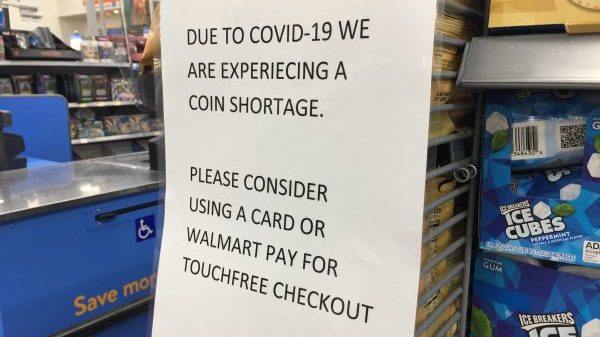
I seldom pay with cash. Nothing against Lil George or DJ Franklin, but it is rare for me to have any need, and paying with a credit card actually earns some cash back (mainly in the denomination of Abraham the Creator). Nevertheless, I have a burner phone that is refilled with smacker payments for the purposes of privacy. As I went about completing the transaction today, I snatched a prepaid card, marched to the Wal-Mart self-checkout, and saw the following sign:

Really. Not only the poor spelling, but each register strictly refused to accept cash, leaving me to drop the card by the register shelves and break the rules by exiting through a one-way entrance. For this I received a stern finger-wagging from the staff, who were terrified that I might spread coronavirus to other shoppers. Strangely enough, the store had closed down an entire entrance, as though having everyone enter and exit through the same spot is a clever way to promote public health.

Regardless, the coin question struck me as grimly predictable. The empowered news media is claiming the culprit to be a disruption of supply due to less circulation. I would argue there is a far more to the story. Many of us have been warning about the danger inherent to a cashless society, even as the authorities that preside continue zealously pursuing it. The boldest step in this direction recently came in the form of Flimsy Andrew, whose campaign centered around direct payments from the Fed to Americans, and elimination of the penny. In fairness to Yang, your money would be worth about the same if his policies went into effect, but that is besides the point.

Why do they hate cash so much? Because it is difficult to control. Someone on Craigslist can offer up a service for a flat rate fee, and pocket the cash upon completion, simplifying the process and eliminating the government’s ability to tax. Transactions are very difficult to keep track of without card payments, whether because the State wishes to monitor a person or some corporation wants to use your buying habits for marketing purposes. The only identifying factor on a cash payment receipt would be the time and whatever video footage is available in-store. Nothing else.

So naturally the pandemic is a great excuse to further diminish the freedom of citizens and consumers in everyday life. It is likely that stores will attempt to maintain these policies in the future, and perhaps prohibit cash payments altogether, unless of course they get accused of waycism for the practice. We can only speculate and see.

Actually, there are more concrete actions which can be taken. Consider starting (or building on) a stash of precious metals. I would stay away from the SLV and GLD trusts, which have unclear guidelines as to the physical ownership of the metal. APMEX is a reasonable option, and there is of course Bezosmart. Be careful with pawn shops or gold stores, as they tend to jack up prices compared to online.

Some things just glitter and shine.

Personal Finance · Self-Improvement

How To Make Clothes Last

Clothing is THE critical issue. Around the nation, it drives people to their weekend or mid-week shopping sprees, greased so often by the need to appear “hip” or “sexy” on the Instagram dot com. Coming off as poorly-dressed is often associated with less respect, diminished romantic prospects, and even difficulty making money.  To show how serious the question is, reports indicate that the average American expels around $150 per month for clothing and related services – no small joke when the average income is under 64k before taxes. The sweatshop stitching intensifies.

Although less common as a financial topic, preservation of clothes is a fantastic way to break from the norm and spare a crying wallet more pain. What’s more, it need not fly at the expense of style or comfort, assuming certain steps are followed. The key aspect is to understand garments for what they are, obtain enough of them, and treat each one with the utmost respect.

Socks

Probably the last thing folks think about, even though they serve such a glorious purpose by keeping feet healthy and comfortable. Everyone knows socks wear out, but far less consider how this can be mitigated effectively. For one, purchase enough pairs so you have two for every day of the week. This allows for swapping at midday, which improves circulation to the toes and avoids too much strain being placed on the fabric. Consider a pair of slippers for the house, and avoid walking in socks on the driveway, where rough splotches can tear at the threads.

Also be sure to invest in a quality darning egg and stitching kit. When the heel or toes begin to show off more skin than a tradcon would approve of, you can fix them up lickety-split. Through this strategy I have been able to maintain pairs of Dickies going back 5 years, which beats purchasing a new pack every few months.

T-Shirts

Here again, quantity helps with longevity. Another useful approach is to buy more synthetic and polyester materials than cotton. Sure, they might feel tacky, but the quick-drying and sweat-wicking fabrics just feel nice, and seem to last longer, even without a Nugenix pill. I’ve had a surprisingly good experience with Wal-Mart’s Dri-Star materials, and you can go premium if that brings more satisfaction. Regardless, make sure to turn them inside out when washing, as this both cleans the fabric better and limits wear on the front. This is doubly true for any shirt (such as a uniform) that has velcro pockets.

Shorts/Briefs

Try to hand-wash these guys, including the sporty versions, as a means of increasing shelf life. I have seen some absolute tragedies coming out of the washing machine and dryer due to the underlying design. Adidas and Nike for example tend to leave the interior stitches exposed, and those threads will wear out rapidly when being tossed around.  If exercise shorts must go in a washer, remember to lace the drawstring up a couple times; doing so prevents it from getting dragged into the waistband by your machine’s impeller.

Pants

While it is fine to throw some pairs in the washer, they should be handled with care and turned inside out. Do not let them sit in the machine after it finishes. Instead, shake them out and place in the dryer for 10-15 minutes before hanging up to air-dry. Placing slacks or jeans in the dryer for long periods of time can result in damage to the buttons and belt loops, or even shrinkage. Get a decent iron and smooth out the wrinkles when they are dry before either folding them for a drawer or hanging the rascals up.

Washing In General

If it is not already a primary theme, limiting the use of washing machines and dryers is important (if not always practical) as we seek to preserve clothing. The reason why I emphasize synthetics is because they require less time in the dryer and can return to wearable status faster on even a lukewarm day than a piece of cotton will. Unless you are big into those fancy Gain or Downy scent pods, just consider a nice environmental detergent and be done with it. The especially brave might even try out a wash rack, but that is only for the muscled arms among you.

Finally, when a piece of cloth must be retired, keep to mind that it might be compostable, or even made into a cleaning cloth. This will not function as well for synthetics, but cotton socks can serve as excellent shoeshine pieces, and t-shirts past their prime become excellent rags or mopping heads. Alternatively, trim them up and add to a compost pile. Nothing wrong with that.

Culturalism · Uncategorized

Democracy’s Free Pass

Historical myopia is incredible. After reading through countless books on the early 20th Century nationalist movements, I have determined there is no Western scholar incapable of twisting events into an indictment of particular figures, strictly on the basis of them not being popularly elected. Wherever and however, they stretch the truth so as to hold anti-democratic regimes accountable for standards far beyond the reach of liberal opponents, even when the evidence is glaring.

Case in point: Benito Mussolini. Most writers will concede that his rule was relatively benign, with the harshest punishment for enemies usually entailing imprisonment on islands or in small villages, not the dreadful conditions of some concentration camp. Nevertheless, they persist, scraping at any random example to find fault. For Mussolini, this is the claim that he killed countless Ethiopians with poison gas, because he wanted their land. The less-examined record of course reveals that the weapon was used sparingly at specific infrastructure sites, and as a response to the African nation’s longtime atrocities, including the use of exploding bullets on Italian soldiers. None of that is relevant though, because he was a fascist, and that makes him a war criminal.  

Now suppose we examine for a second the legacy of Barack Obama, our former commander-in-chief. As president, he authorized the killing of over 3,700 people using drone strikes, with over 300 of those being civilians. More than this, he went so far as to brag about his ability to end the lives of the targets, most of whom were brown Middle Eastern people:

“Turns out I’m really good at killing people. Didn’t know that was gonna be a strong suit of mine.”

His crowning achievement in this regard was the shelling of Libya, which culminated in an attack on the convoy carrying Muammar Gaddafi. The Libyan leader reportedly asked his attackers “What did I do to you?” as he was sodomized with a bayonet , beaten, and shot to death. Then-Secretary of State Hillary Clinton (another empowered product of democracy) cackled about the killing, saying “We came, we saw, he died.”

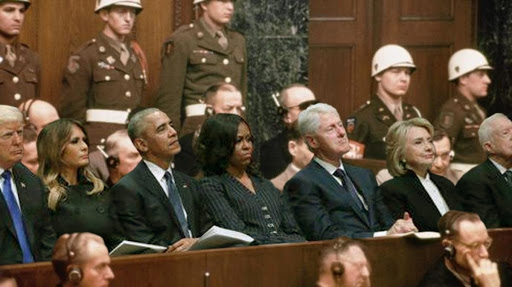
Just like that. Pure sadism and mass murder, yet how many scholars have written (or will write) books describing Obama as a war criminal? Will Hillary sit awkwardly in a Nuremberg defense box, awaiting the ultimate penalty? Might children grow up absorbing histories about the cruelty and vicious nature of these figures, and how justice was done?

Of course not. They were democratically elected, and therefore all actions taken, whether for “national security” or “the promotion of human rights,” stand to be moderately brushed away as acceptable. Sure, one or two historians will bring up the drone issue, but only as a minor footnote on the page of “controversy,” a term which alone nullifies all seriousness. Chances are, such creatures will end up being celebrated by children for their bravery, tenacity, and progressiveness.

Cast a few votes, and suddenly the rules don’t apply.

Uncategorized

Decoding Corporate Propaganda Speech

Since the advent of consumer capitalism, corporations have gone out of their way to design economically subversive messages which promote their own well-being. This practice has only heightened during the age of social media, and morphed radically after the corona became a thing. Being able to read between the lines of these messages makes a person substantially smarter when it comes to financial and political decisions. For the benefit of my blog audience, here are a few of the most common.

“In these challenging/uncertain times…”

Translation: Our bottom line is struggling, so you need to pay attention and find a way to be a good consumer despite the lockdowns.

“We’re in this together/We’ll get through this together.”

Translation: You as a spender must join the other spenders in the chip-inserting community to save our profits. However, don’t you dare feel togetherness based on religion, race, or anti-globalist philosophy. Those things are still prohibited, and we will fire you for expressing any of them.

“It is important to follow science, not debunked or discredited ideas.”

Translation: Make sure to purchase the vaccine, which will probably be mandatory anyway. Never attempt to medicate through lifestyle changes or vitamin therapy, as this could cause you to die. Of course our treatments for COVID-19 and cancer are extremely dangerous and have terrible side effects, but don’t worry about that.

“They were not consistent with our values, so we terminated their employment.”

Translation: We are not going to bother considering the context of what happened. Twitter mobs are scary, so the employee must be fired, even if they did a fantastic job.

“Let’s celebrate these empowered individuals for their contributions.”

Translation: Stand up and clap for this talentless person who needs recognition for their gender or skin color.

“Please wear a mask.”

Translation: Obey.

“We need tax cuts for job creators.”

Translation: The money NOT being sent to the Cayman Islands is being taxed too high. Stop that.

“Enough with these job-killing regulations.”

Translation: We didn’t lobby enough to make the regulation as we liked, so it needs to go. If you get poisoned because of this, at least remember that all that growth helps your 401k.

“These entitlements are out of control.”

Translation: People need less generous retirement plans. Don’t mind us as we take fat tax deductions and raid employee pension funds.

“Immigrants work harder than Americans.”

Translation: We can pay immigrants a hell of a lot less.

“We need more high-skilled worker visas!”

Translation: College graduates in America are asking for respectable salaries to pay off their student loans. This is unacceptable to us.

Uncategorized

What Is the End of Growth?

I recently slogged through the extreme future by James Canton, a somewhat outdated tract fitting the Thomas Friedman-style, “Wowsers trousers, just think of the future!” that we are all too familiar with. Across three hundred or so pages he lays out projections about the next twenty years (speaking from the ancient milestone of 2007), and warns actors both private and public of the risks entailed by failure to abide by the horizon march. Towards the end of the screed, he conjures up startling visions of what might occur if states fail to ensure streamlined business processes, access to education, and open borders. The greatest casualty according to Canton will be the mystical rocket of economic growth, which exists like a sacred idol in the bonobo village.

Canton’s fixation upon this concept made be pause, as I have many times before, trying to understand what the genuine motivation is behind it. Growth has always ebbed and flowed over time, yet the neoliberal order seems to think perpetual upward movement, whether in stocks, home building, or population expansion, is as important as the Fatherland for a Fuehrer, or the Virgin for a Catholic. Nothing else factors in this calculation, because its girth transcends and drowns the very possibility. Failure to agree and accede is portrayed not as an opposing view, but the laurels of a death cult dedicated to seismic decline, or traditional socialism.

But of course we must question the underlying merits of such a worldview. Growth may increase wealth, but it also contributes to the planet’s destruction, to the wisp of the air and the spill of green landscape where virtue finds rebirth. Expansion widens the collective GDP, while also defying intent for culture and legacy, letting purpose devolve between the anarchic barbs of nihilism, itself directed towards the accumulation of more, if by less legal means.  Liberal economic ascension permeates and fills all places, but leaves them emptier than before, embittered by the absence of nothing, by the tragic search for meaning.  

Even dismissing the philosophical considerations, what can this “growth” really provide to humanity? The effervescent obsession with mass migration and diversity—whether to fill underpaid jobs or pay our pensions—does it have any limit? If ten million souls skip from one imaginary line to the next, occupying and developing increasingly-scarcer territory, does their family left behind cease to replenish the human stores? At any point might the Salvadoran population decline, or is that nation destined to eternally reproduce—simply to keep the Stars and Stripes at maximum GDP? Might there be an hour when they wish for fatter pension pots, and tire of serving our own, turning to demand the same econo-destiny shackles be placed on the eager Guatemalan, or perhaps the souls of Congo? Per chance those new selections are expected to fill their role, because otherwise the chattering national product stats might drop.

What growth actually leaves in its wake is a rancid and soulless question; an ode to the unending desire to subjugate and own, if merely for the extent of the taskmaster’s life and pocketbook. The yolk today is not based on the simplicity of race, nor religious divergence, but rather the dibbling spots of numerals on a digitized trading screen.  The worth of man, computed by ones and zeroes, in offices he yearns to escape.

But where can he run?     

Uncategorized

The Ministry of Approved Facts

It has been debunked and discredited.”

“This is settled science.”

Most of you have probably heard one of these phrases tossed around on the Twittersphere, or megaphoned by our wonderful cable television networks. The message is meant to be authoritative and calming, typically delivered by someone in a white coat, a classy suit and tie, or with “PhD” appended to their name. Everything is fine, they communicate softly. Now get in line for your own good.

It’s fantastically convenient: the media, corporate, and political establishments circle the wagons, sternly finger-wagging at anyone who breaks the norm, despite how incompetent that position happens to be. Wherever opposition rears its eager head, they crack down, thrusting that maternal-statist inclination to setup a bureaucracy and fillet out anything “problematic” or “pseudo-scientific.” All that remains is their version of the truth, itself lathered by so many social chemicals and engineered conspiracies that willing followers are left to regurgitate a blind order they do not understand, but everyone else is expected to obey.

Remarkably, I happen to feel rebellious at the sight of their leering faces. Per chance the fault goes to excessive reading and contemplation of the right books, or simply too little of the wrong ones. At any rate, the moment an offering of these statements enters my earlobe, I begin to doubt the validity behind them. There are simply too many examples of wanton lying on the part of the institutions and authorities that humanity has been told to trust throughout history. In America alone we were lied to about the cause of the Second World War, communists in the federal government, corrupt acts of the CIA, and the Iraq invasion. The media routinely lies and misrepresents crime reports, creating the foundation for mass the mass violence permeating today.

“Yes but those are political issues, not medical!,” you might desperately shriek. Ahh, but there the story is not much better. How many folks took Zantac over the years because it was FDA-approved? Did the illustrious seal of government and established medicine make a difference? Why still do we see such vicious attacks on vitamin-based therapies, or the use of colloidal silver as a treatment? Could it be that the Ministry is protecting its financial interests? These organizations love to celebrate freedom, yet go ballistic when someone exercises those rights regarding self-medication.

The present situation causes me to speculate that in the future Americans will be mandated by law to pursue specific treatments for illnesses. Feel sick but don’t have corona? Doesn’t matter, because the hospital says you do.  Cancer treatment using destructive chemotherapy will also be mandated, as the science simply cannot be challenged. Just ask smiling Dr. Raj, whose medical school tuition was funded by Eli Lilly the Squibb. Be a good boy and settle in for the feeding tube, and just remember: we know what’s best for you.

I’m thinking hard of ways to agree, and the only problem is, I can’t stop thinking.

Uncategorized

How To Keep Cool Sleeping In Your Car

We have previously discussed how to stay warm while practicing van life or car camping. Now as the weather advances towards the extreme of summer, it is crucial to discuss strategies on maintaining a comfortable temperature against the sunlight scourge. After all, sweat might build muscles, but sleeping with a thick layer on the skin doesn’t quite hit the spot, unless sauna sleep has some type of hidden benefit.

Pick Your Location Wisely

Humidity can always be an issue depending on the region, yet there are ways to diminish the overall burden. For starters, choose a spot where the sun don’t shine (not in the traditional sense), such as a shaded area of the parking lot of neighborhood street. Run a quick orienteering check using a physical compass or an app like Digital Compass. This should give you a good sense of where the sun will rise and set, and allow for optimal positioning of the vehicle to avoid those adamant beams.

Block The Heavenly Fire

Once the sun’s placement has been determined, look at the windows and figure out if they need reinforcement. Even tinted panes can benefit from some added love, whether in the form of a peel and stick screen or the classic suction cup options. I personally have used a model similar to the Enovoe version, finding respectable success. If there is a way to lie down that locates your head away from direct window shine, consider that option. Few things are less pleasant than waking up to a bolt of sun right between the peepers.

Bed Down Right

When it comes to the choice of a mattress, materials matter. Some folks opt for raised platforms and will attempt to build a normal Sealy shindig inside their vehicle. This strikes me as unnecessary. A couple of solid foam sleeping mats topped with one or two inflatables should be adequate. The material works well against sweat and is often designed to keep body temp where it needs to be. I advise using this Wakeman foam option, the Coleman Self-Inflating pad, and the Wellax sleeping pad.

One the same subject, a sleeping bag’s nature is important. Obviously during the summer you don’t want some thick ass deep cold option like the WolfTraders version, although it works great for colder weather. Instead, a basic Coleman bag or simply a light blanket can suffice. I use an older version of the Mummy Bag, which is actually a bit warmer than is ideal. Especially in humid areas, being locked inside a bag won’t be fun, so you will probably unzip it at some point.

For a pillow, finding something light and cool remains absolutely paramount. I personally have employed a MyPillow Medium Fill for some time now, and find it to be more than adequate. The key is to use a light pillow case so your head does not sweat too much. Alternatively, there are specialized options such as the TEKAMON available for use.

Become The Airbender

The general humidity on a hot summer night cannot really be controlled, but there are valid ways to cope with it. First on the list would involve securing a good battery-operated fan. These can be charged at the library or at work with a USB cord and provide respectable circulation for between 8-10 hours on low speed. In the past I have employed the AceMining model, which is fantastic. It charges in a little over 2.5 hours and will run well past 12 hours without difficulty. In addition, the Holmes option is respectable, and actually runs much longer than the advertised 6 hours. Unfortunately, charge time clocks in around 4 hours, which is a lot less convenient. The advantage with each one is the low price tag, so you can snag 3-4 without blowing the bank. I also meant to check out the solar-powered fan offering from STYLOOC, but the reviews turned me off. Maybe they will improve performance in the future.

Preparing for the Sweat

While it is difficult to prevent the glands from opening up, there are some ways to make the experience more comfortable. Dressing light is an obvious strategy, but retiring for the day in a dry state (by cleaning off existing sweat) makes things much better, and you avoid rolling around in excess sweat from the start. Applying deodorant before sleeping will also improve on this front, holding in the sweat for a longer period of time.

Another valuable factor can be the use of a re-hydrating towel. These guys can be soaked and then rung out, but will reactivate when the body sweats during or after a sleep. The flagship brand is Frogg Toggs, but I opted for a third-party brand that offers larger sizes, because I am also a pretty big guy.

Uncategorized

How To Lose At Economic Dating

Robert De Niro is angry. He’s furious about Trump, about clowns, and the sun drying up earth into a massive desert. What’s more, he’s an actor, so you best zip up and listen. It’s true that he might have benefited from zipping things up in the alimony department, but you’re just jealous of his fame and fortune (or whatever is left of it).

Sure, I hate to be passive-aggressive on my own blog, but Robert De Niro is a great example of how the marriage industry can fell a person, no matter how progressive and giving they happen to be. The fresh word is that De Niro’s twice-divorced wife, Grace Hightower, is not content with the financial limitations he had attempted to place on her:

“Hightower, whom De Niro married in 1997, requested that the actor raise her monthly American Express allowance from $50,000 to $100,000. But the Post reported that the New York judge on the case denied her request, ordering De Niro to keep her credit card limit at $50,000 a month and to pay her $75,000 so she can find a summer home for their two children.”

Not surprisingly, her lawyer is infuriated, claiming “Mr. De Niro has used the COVID pandemic, my words would be, to stick it to his wife financially.”

In all fairness, Robert has probably been sticking it to her many times before, so Grace’s pent-up anger could be justified. Funny enough, part of Don Corleone’s defense is that he’s not making enough money:

De Niro “is going to be lucky if he makes $7.5 million this year,” Caroline Krauss, the actor’s lawyer, reportedly said. His prenuptial agreement stipulates that he owes his wife $1 million each year as long as he’s making at least $15 million a year, and the spousal support will be adjusted proportionally should De Niro make less than $15 million. He is only projected to rake in $2.5 million.

Well fancy that. Making more money in twelve months than most will in a lifetime doesn’t quite cut it because of his empowered dating strategy. It’s almost like celebrities are out of touch hypocrites who cannot manage their personal lives but wish to dictate how everyone else ought to live.

Some time back De Niro discussed Donald Trump and said “I’d like to see a bag of shit right in his face. Hit him right in the face like that, and let the picture go all over the world.”

What goes around comes around.

Book Reviews · Culturalism

Russert Family Wisdom

This past week I read through Big Russ and Me, an autobiographical tale from the late Tim Russert, one of the last genuine journalists in America. Although a self-described Democrat, he made an effort to present unbiased and competitive material on Meet The Press, heralding an era of media practice which has long since ridden off into the glorious sunset. Unsurprisingly, his book is filled with exceptional anecdotes and lessons in wisdom from both himself and his father, so I decided to recount some of them in this post.

On Meeting People

“Dad insisted on a firm handshake, and he worked with me until I developed one. ‘When you meet somebody,[…] you want to make them feel that you’re proud and happy to know them. So don’t put a wet fish in their hand. Give that hand a good shake, snap your wrist, and look them in the eye. People are people, and if they like you, they’ll give you the benefit of the doubt. Treat them the way you’d like to be treated.’”

On Family Honor

“All I’m asking—wait, I’m not asking, I’m telling you—is, Don’t do anything to embarrass our family name. If you embarrass yourself, you embarrass all of us. We all make mistakes, but if you go out there and do something you know you shouldn’t be doing, that’s a tough one.”

On The Role of a Father

Russert talks about growing up in Buffalo, New York during the 50s and 60s, when most men held two or three jobs to make end meet. This was simply the way of life, although I’m sure it might seem like a anathema to some of the manosphere. He sums it up as follows:

“The primary obligation of a husband and a father was to provide for his family, and if it meant working two jobs, that was what you did.”

On Identity Politics

During the 1960 presidential campaign, Russert describes the excitement among Irish Catholics over the ascendancy of John F. Kennedy. His father’s friend Edwin Dill asks him about this:

“Timmy, why are you for Kennedy?

“Because he’s Irish Catholic,” I replied.

“And if there was a barber who couldn’t cut hair, and he was Irish Catholic, would you go to him?”

On Weak Parenting

“In this respect, I believe that parents of my generation have often failed our kids. We are so eager to be understanding and sympathetic that we end up being too lenient, even as we further undermine the already diminished authority of teachers, coaches, and principals.”

On Buying a Luxury Car

After Russert made it big in the news media, he offered his father any luxury car he wanted as a gift. “Big Russ” asked only for a Ford Crown Vic, with the following explanation:

“Do I think it’s  a better car? No, of course not. But If I came home with a big fancy Cadillac, do you know what people would say? ‘What happened to Tim? He’s showing off. He got too big for us. His kid made it and how he’s driving a Cadillac.’ No, I can’t do that. A Mercedes? A Lexus? Can’t do that either. We beat those guys in the war. This is what I want: a good American car. This is who I am, all right?”

On Student Loans

His father had an interesting idea of student assistance for college which makes a lot of sense in principle when we think of the national debt problem:

“If you can’t repay those loans, that money won’t be there for the next kid.”

“The sooner you pay them off, the sooner that money will be there for somebody else.”

On the Vietnam War

‘’We can be for peace without supporting the enemy. We can be against the war without rooting for the other side.”

On Human Loss

After a childhood friend of his died, Russert’s dad attempted to comfort him:

“Would it have been better if Paul’s family had never known him? Or should they be grateful, even in their grief, for nineteen years of love and memories? Mr. and Mrs. Lawrence had suffered a terrible loss, but if they had been offered the possibility of having Paul in their lives for nineteen years, they would have taken the deal without question.”

On Advice For His Son

“You do, however, owe this world something. To live a good and decent and meaningful life would be the ultimate affirmation of Grandpa’s lessons and values. The wisest commencement speech I ever was all of fifteen words: ‘The best exercise of the human heart is reaching down and picking someone else up.'”