Culturalism

How Technology Destroys Customer Service

“Dynamic technology is changing our lives for the better.”

We have all heard something along these lines over the past two decades. First it was the Internet.com, then smartphones, now smart everything. The oft-celebrated Internet of Things is forecast to make existence more convenient, less time-consuming, and more user-friendly.

Sure, tech has created positive change and unified people across the world. It has given us new industries, aspirations, and means of communication. All one must do is dream, and type in a Google search.

But there is something else: the wondrous change has  allowed corporations to turn a middle finger to the individual consumer. The customer is no longer “right” in our world; as an entity we hardly exist. In fact, we remain little more than a credit card swipe and a flicker of lights in the data center’s tower aisle.

I was thinking about this yesterday as I picked out an appliance for my new house. Being the deal-sensitive person I am, I went on the Bank of America app to change my cashback category to home improvement stores. After all, why not get twenty bucks back on a sizable purchase?

As it turned out, the app did not permit me to change the category, and advised logging in to online banking, which I did. On the website, I received a message saying I needed to use to app to change the category, or login to online banking. Obviously, neither option worked.

Feeling rather annoyed, I tried using “Erica,” the virtual assistant. When I inquired about the category change, she feigned digital ignorance by asking me to repeat the question. BOA’s customer service number was no better, leading me through a maze of menu options before claiming to “not understand” the request.

You might say this is a one off, but I’m seeing it regularly. Last year I booked an appointment with Best Buy to have a remote start installed in my rover. I paid the fee, got numerous reminder emails, and drove almost an hour to the GeekSquad bay. The door was locked, and no one answered the phone. After finally getting in touch with the manager, she bluntly announced that her technician had quit the previous week.

Instead of exploding, I calmly called Best Buy’s customer service, where I ended up speaking with five different representatives, each holding unique titles and demanding I repeat the story over again, before they made up an excuse to transfer me. I was stonewalled continuously, and eventually disconnected from the “Customer Care Manager” who could barely speak English.

Around the same time frame, I ordered a video game on Amazon as a Christmas present for a family member. After my other items showed up, I saw that the game was delayed by almost a month. I promptly attempted to contact Amazon and cancel the order. Like with the others, I was led through an endless maze of virtual assistants, disconnected numbers, and general indifference. All for something that should have been a simple, one-click solution.

Of course one cannot email any of these companies anymore, because they don’t want a paper trail if the underlings screw up and promise something they refuse to afford.  At best you’ll get to use chat, or maybe a 1-800 number. How joyous.

But at least we have “smart” refrigerators.
investing

Don’t Be The “I Should Have” Guy

Humans are not as adaptive as one might think. Right now, the economic herd is stampeding out of investments, many at a loss, because that’s what everyone else appears to be doing. Because Coronavirus is scary.

You can do the same (or not start investing to begin with), and the outcome will almost certainly be a loss, or missed opportunities.

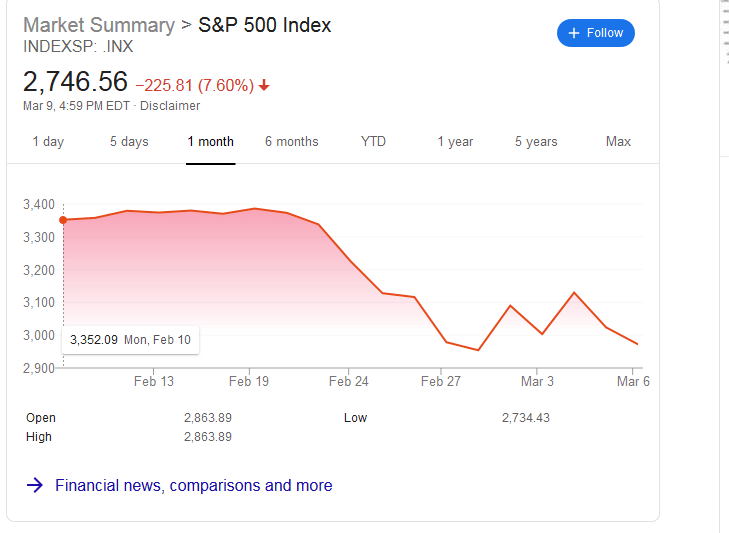
Look at the market right now. We are on a roughly 11 percent decline in the S&P 500 since the end of February, with today’s 7 percent drop overall and the crush of oil bringing it home. At bare minimum, the market is much cheaper than it was a few weeks past.

If you break into individual  funds, the story is more stark. QQQ shares are down by $43.00 since February 19th, or 18 percent. SPLG is off about 7 bucks, or 17 percent.

What about loner stocks? Well, we have AMD down $15.00, or almost 26 percent. CCL, cursed by its exposure to virus-impacted cruises, lost 22 bucks, or 48 percent since February 19th.

And this is just a small sample size. Stocks are on sale. If you have free money, or a retirement plan through work, give strong consideration to buying in now, and certainly if there is a further decline. Drops of this nature don’t come frequently, but once they do, money will be made by the patient and unemotional .

Or, you could be the guy saying, “I should have invested back then.”

investing · Personal Finance

Siegel: The 60/40 Split Is Outdated

The 60/40 portfolio divide between stocks and fixed income is old news.

That’s the word from Jeremy Siegel, the Wharton professor and renowned author of Stocks For The Long Run. He made the point on CNBC that our enduring low interest rate environment means you need a higher concentration of equities in an investment portfolio. What’s the new ratio? It swings in at 75/25 percent, stocks to fixed income.

Here’s the video:

As a side note, the author of How a Second Grader Beats Wall Street uses the 60/40 split for his son’s portfolio, but the 40 percent is actually made to include an international equity fund. He puts 60 percent in VTSMX, 30 percent in VGTSX, and 10 percent in VBMFX. While the regular stock fund (VTSMX) performed well for the period discussed in the book, the VGTSX lagged dramatically.

The ultimate decision on allocation should relate to the investor’s age and specific time frame. Unfortunately, ultra-low rates will make it harder for older folks to adjust because their fixed income returns stand to get decimated by the inflation figures.

But that’s ok, as long as we have good GDP.

Culturalism

Let’s Talk About Sexism

It wasn’t moments after Elizabeth Warren called it quits that our girls at Hufflepuff had put out an article attempting to deflect her failure onto the alleged “sexism“ of primary voters. The article, which reads like a winsome, brooding teenager, features the following quotation from Rebecca Katz:

“At a certain point, the narrative that a woman can’t win and that a white man would be the safest candidate to take on Trump became self-fulfilling.”

Fascinating. At what point was that? When John Delaney and Seth Moulton dropped out? Before or after Buttigieg conceded? Somewhere in Tulsi Gabbard’s universe?

The argument is a ridiculous one, seeing the advantages that Warren held going in, including superior name recognition, and a status as one of the two main progressive options for voters. She even led in primary polling for a period last fall, and had no shortage of speaking time at debates, especially towards the end of the cycle.

No, this post-disaster claim about leftist women who lose needs to be put in its place. Whenever a man is forced into the position of losing to a woman, society will relentlessly mock him for it using crude gender assumptions, but still insist he be a “good sport” and concede honorably.

On the flip side, a progressive woman is NEVER at fault for failing to win in her own right. We all remember 2016, when Clinton’s demise was explained away using the sexism crutch, with special emphasis on Trump’s “looming” behind her on a debate stage. As if that was too much for her to handle.

 If humans want to achieve real equality, then we should stop giving leftist women an easy way out of moments when they lose face.

Does that make me sexist?

Culturalism · investing

How The Spanish Flu Hit Stocks

There’s been a gross deal of speculation about an (even bigger) Coronavirus outbreak, one that could cost countless lives and send the world economy into tailspin. It makes jolly good fodder for the internet activists of our time, but how accurate is the claim?

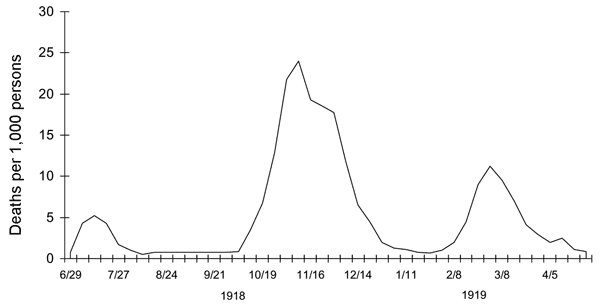
That depends. The folks over at Global Financial Data put together some nice info looking at the 1918 Spanish Flu pandemic, which killed tens of millions of people. The first graph shows the various peaks of the outbreak those years ago:

Credit: GFD

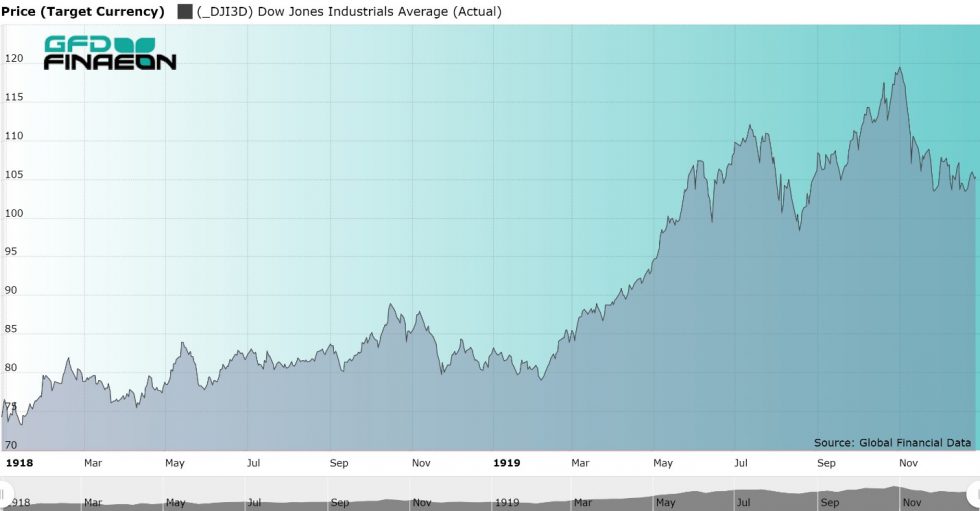
Next we have a trace of the stock market:

Credit: GFD

As you can see, the market was not visibly impaired by the rise of the flu, although the period also encompassed part of World War I.  After the nominal end of the flu wave, which was relatively close to the finish of the First World War, the market experienced a period of handsome growth.

The applicability of the 1918 situation to today, or vice a versa, remains dubious, and yet it suggests that hysteria may not be the proper answer.

investing · Personal Finance

We Can’t Take Rate Cuts Back

Josh Brown said something on CNBC today that I’ve believed for a long time under the Trump Economy: it’s now impossible to walk-back rate cuts.

We all remember the debacle of December 2018, when the Federal Reserve raised rates by a quarter point, from 2.25 percent to 2.5 percent. The result was a devastating market drop of 20 percent.

After the last seven days of Coronavirus fear and loathing, the Fed made an emergency rate CUT to stave off concerns, and the Dow fell by almost 3 percent. I guess it wasn’t enough, but just imagine if they had attempted to RAISE rates.

Much as Religious Investor thinking may help quench queasy market appetites by feeding the “There’s no limit!” mentality of millennial dreamers, fueled by the likes of Tesla and Virgin Galactic, at a certain point the ties which bind may horribly snap.

In that moment, will rates be cut or raised? Will it even begin to matter?

Culturalism

Does Anyone Bother Reading?

Sure, Breitbart’s comment section is a poor sample size, but let’s humor the gods for a moment. We have a story entitled “Italian Governor Quarantines Himself After Staffer Tests Positive for Coronavirus”.

While the piece doesn’t explicitly name Attilio Fontana’s political affiliation, it helps clue readers in by noting his criticism of the Conte Government’s response to Coronavirus. Additionally, there is mention of  Matteo Salvini’s negative opinion of Conte, suggesting kindred feelings on at least that issue.

Fontana is also regional president of Lombardia, one of the two more reliably right-wing provinces of the Mediterranean country, and  a hotbed of support for Salvini’s Lega.

With all that information available, how does the empowered Breitbart reader respond? By assuming he’s a leftist. Here we go:

“Oh poor baby leftist runs and hides!!! No lossless he does the better off the country will be. Whata bunch of flakes the Italians are.”

The same commenter made this reply to a different article, also on Italy:

“WHY was Salvini voted out?!?!?!!? These people are nutz and get what they deserve!!!!!!”

Folks, with the advent of the Google search, it’s not that hard to square information before making a statement. Just count to ten and breathe.

Culturalism · investing · Personal Finance

How China Got Away With Murder

We have already established that China is untrustworthy and corrupt. But the story gets a lot worse, and it goes back years.

In 1874, the Treaty of Bern was signed, establishing the Universal Postal Union, which served to set international carrier rates for mail and shipping. Because China was considered a “developing country,” then, and explicable still is today, it got a sweetheart deal on shipping to the United States. Although less of a problem intially, the growth of China’s exports resulted in a system where the USPS was paying between $300-500 million annually subsidizing foreign imports.

The bizarre impact of the old policy meant that a New Jersey-based company like Mighty Mugs had to spend $6.30 to deliver a single mug, while a counterfeit version could be sent from China for only $1.40. According to Mighty Mugs owner Jayme Smaldone, it gets worse with heavier packages:

“We pay up to $17.61 to mail a four-pound package, but a shipper in China pays $3.67.”

It should come as no surprise that Chinese knockoff sellers can easily undercut American products by offering significantly lower prices.

Thankfully, things are changing. Under a new agreement that goes into effect in July 2020, the United States will be permitted to self-declare shipping rates, hopefully leveling the playing field for struggling small businesses within its borders. As Pete Navarro said:

“China is certainly going to pay more for the privilege of shipping to our market.”

And it only look over 100 years.

Culturalism · Personal Finance

Money Doesn’t Equal Dignity

“You need money to have human dignity.”

Nowadays we have a lot of public discussion revolving this concept. People claim increasing the minimum wage, expanding healthcare, or offering free education serves to avoid the negative outcome. And that sex workers and porn artistry are “last resorts” for women struggling in a moribund, patriarchal world.

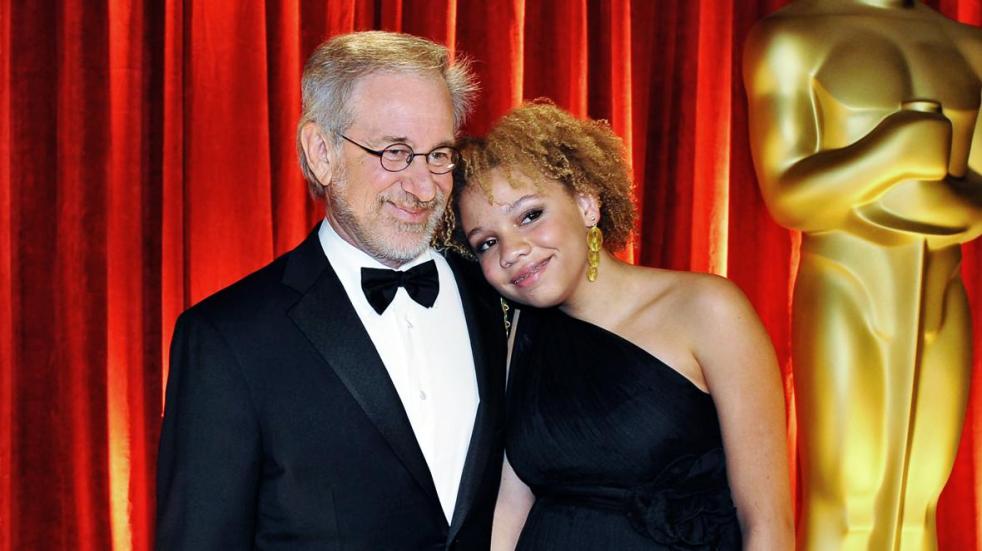
But oddly enough, having more means nothing if your personal code is bankrupt. Take Steven Spielberg. He’s a world famous influencer with a fantastic career, and more money than most could imagine. Yet reality is a cruel mistress.

His adopted daughter, Mikaela, recently came out about her pornography career, which she describes in the following terms:

“I’m doing this, not out of an urge to hurt anybody or be spiteful about it, I’m doing this because I want to honor my body (emphasis added) in a way that’s lucrative.”

Remember, this is the child of a mega-rich Hollywood power couple (who are apparently supportive of her choice). She likely had access to expansive educational, healthcare, and career-oriented resources throughout her life. Even if we want to ascribe the cause to various forms of abuse she experienced growing up, the specific avenue of pornography was certainly not a “last resort” for her in terms of a career, which she admits to pursuing.

So Bernie and Lizbeth can continue waving their hands, but having more means nothing if you possess no dignity.


investing · Personal Finance

The In-SECURE Act

I have a general rule for life in the United States: anything which saves you money is eventually removed.

A few of you may know about the passage and signing of the SECURE Act in December 2019. This drama-free legislation made some interesting reforms to retirement plan rules, allowing Americans to make certain penalty-free (but not tax-exempt) withdrawals for qualifying reasons, and also lengthened the timeline under which required minimum distributions (RMDs) must be taken by retirees.

That all sounds good, but there is something else to the story. A separate shift in distribution laws could leave you seriously screwed down the road where taxes are concerned.

Under previous rules, people who inherited an IRA from their parents had the liberty of “stretching” RMDs over the course of their own lifetimes, thus reducing the taxes paid on that money and building inter-generational wealth. Not anymore.

The SECURE Act upends this tradition by placing a 10-year distribution requirement on such inheritance IRAs. So if your parent dies and hands over an account with $500,000, you would need to withdraw something like $50,000 annually to spread it out over that period, or take the lump sum. In either case, taxes will be high.

Perhaps the rule won’t be so horrible for folks who inherit at the age of eighteen, but for others it is bad news. Imagine pulling in a six-figure salary at age 45 and having to stack $50,000 on top of that. Your taxes will giggle with delight.

A broader issue relates to how America prevents people from building wealth if they are not extremely rich. Under current tax laws you can even be penalized for making too much while also maxing out a Roth IRA, and few lucrative deductions are available for middle class people. The SECURE Act is just a garnish on that system.