investing · Personal Finance · Uncategorized

Expense Ratios Simplified

What the heck is THAT?

We’re talking about the elusive “Expense Ratio,” which governs some of the charges passed on to the investment fund participants by money managers. In most cases, this figure will be something like 0.04-0.99 percent, numbers that successfully flummox the mathematically disinclined. They don’t look expensive, and in fact they really don’t seem like much at all.

But the truth is in the fee lines. If you go by the first glance, it is easy to end up paying hundreds if not thousands of dollars worth of expensive charges that eat away at the base return.

Consider the following S&P 500 options for a second, and keep in mind that the returns are a few months old:

American Funds AMCAP Fund

5-year return:  8.94%

Gross and Net Operating Expenses: 0.36%, or $3.60 per $1000

Vanguard Institutional Index Fund

5-year return: 9.63%

Gross and Net Operating Expenses: 0.04%, or $0.35 per $1000

Those numbers make a BIG difference, and we’re not even including the other administrative fees. Plugging them into a calculator we get:
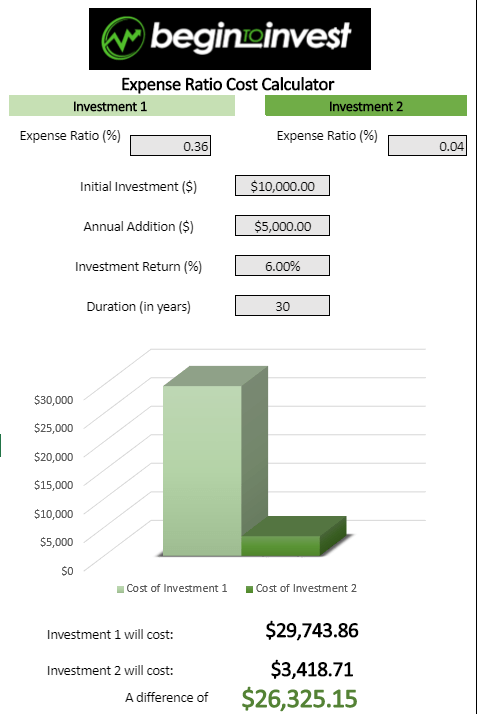
A difference of over $26,000 over thirty years, all while the participant thought he was “saving” money.

Now let’s look at a bond fund for comparison:

Ivy High Income Fund

5-year return: 3.91%

Gross and Net Operating Expenses: 0.57%, or $5.70 per $1000

What’s really sad is that the bond fund has a much lower return, and yet charges higher fees, eating away at growth for the saver or retiree. Expense ratios DO matter, even if they seem like legalese at first glance. Choose the low-cost fund whenever possible


Uncategorized

A Warning About H&R Block

For those of you considering H&R Block for taxes this year, it’s worth paying attention to a rather dishonest ruse they employ to generate money.

On Amazon, a popular option is the H&R Block Tax Software Deluxe + State 2019, which offers a special wherein you get a 4 percent bonus gift card on any refund total. It currently retails at $29.99 and sounds great, but things should be broken down a bit more for clarity.

Let’s take a look at the feature bullets:

  • Five free federal e-files and unlimited federal preparation and printing
  • One state program download included – a $39.95 value
  • Guidance on maximizing mortgage interest and real estate tax deductions
  • Reporting assistance on income from investments, stock options, home sales, and retirement
  • Quickly import your W-2, 1099, 1098, last year’s personal tax return
  • Free live product help via chat – or get tax help from a tax expert for a fee
  • Help Center has more than 13,000 articles, frequently asked questions, and tips in case you get stuck while preparing your taxes
  • Must allocate all or a portion of Federal refund to Amazon.com Gift Card to receive 4% Refund Bonus

In other words, you (or the household) is probably covered under the five free federal e-files, assuming it’s not a massive family. However, while you do get ONE state program download, you receive ZERO state files with the bundle.

How much does a state file cost? Oh, just $19.95, or roughly SIXTY PERCENT of the price tag for the “Deluxe” package:

Imagine doing that for several family members, and all of a sudden you’re at eighty bucks so that H&R can SUBMIT the return. And in case the family is too large, or you foolishly purchased a less fancy package, expect to pay $9.95 per federal return to e-file:

But don’t worry, cause it’s “Deluxe.”

Uncategorized

How I Chose a Laptop

In my book on van life, I wrote about my struggle surrounding the purchase of a new vehicle. You never get exactly what you want, or that very thing ends up with a crucial flaw unmaking its viability.

When it comes to a new laptop, things are much the same way. Too cheap means poor quality, but sometimes going pricey isn’t much better. The carnival marches on.

Initially, I set out with the objective of securing a machine that would properly balance between gaming, video editing speed, and a large storage capacity. The first aspect was less important, as I don’t game much anymore, but it’s rare to find a model with a basic graphics card which can do the others equally well.

After some preliminary searching, I found the Acer Nitro 5. This guy seemed to have the right combination of features for a good price, although it also appeared too good. As it turns out, the model enjoys subpar battery life, and the build quality plus graphics card are not terribly impressive. Furthermore, Acer’s reputation is spotty, to say the least.

Buoyed by some positive comments about Asus, I investigated the TUF FX505DT, which was a step up from the previous one, albeit still at a solid price. A couple of factors turned me away from it though, including the limited storage options and mediocre reviews for the Ryzen processor. To be fair, reviewers may be techies themselves, but for me a laptop is a long-term investment, not something for a couple of years.

Another one that received attention was the Lenovo Ideapad L340, a feller with good general reviews and a largely positive manufacturer reputation. I have heard that Lenovo’s quality declined over the past few years however, probably driven by the same industry obsession with cheap build material to subsidize costs.

I would almost end up pulling the trigger on the L340, save for it’s less capable processor and, once again, poor storage options. Someone will start screeching about the cloud or externals right now, but I’m, old-fashioned when it comes to memory.

My final and conflicted stop would be with the HP Omen 15-CE198WM. I currently own an HP that has lasted almost eight years, and the Omen offered a decent provision of storage, graphics performance, and speed wrapped up in one. Probably a bit too expensive given the age of the components, but I’m happy with the results thus far. My biggest gripe would be the fan noise and slightly jagged edges on the exterior.

Regardless of what you choose, a laptop is prone to having issues at some point, so I elected to purchase a 4-year protection plan through Asurion, which is less costly than options from other providers.

Uncategorized

What If Success Destroys You?

Being born in the West – or migrating here and getting steeped in its culture—means meeting certain expectations: you must dive into the rat race, striving for the highest level of education and salary possible. Choosing to be a non-conformist is unacceptable.

But what happens when a person makes that choice? It’s one of the greatest conflicts of liberalism, a matter usually explained away as the fault of mental illness, extremism, or laziness, each reason carefully avoiding any legitimacy. After all, liberalism only works if our lives collectively obsess with growth.

Of course the world is more complicated than the Liberal State likes to pretend, and the cracks are beginning to show. Take this article from our lovely sisters at Hufflepuff. It tells the story of a “model minority” who slaved for years to get into a good school, only to drop out after a few weeks.

Is she a white supremacist? A person struggling with autism? Perhaps an angry misogynist? Some other thing that liberalism can avoid responsibility for?

Apparently not. The young lady was burnt out and destroyed by the stresses and pressure of Liberal Culture. Consider the following quote:

“I knew deep down that I was only following the path designated to me through expectations. I was following the promise of fortune and success as defined by my parents.”

True enough. The fixation she had ingrained on status and material success led to insomnia, stress, and her search for a simpler, albeit not as spotlight-hungry existence. Imagine that.

I would argue liberal superiority is slowly dying. Over the next several decades, we shall bear witness to how successful its maniacal devotion to economic growth, aimless diversity, and atomization has become.

Uncategorized

Treadmill Rage

I’m kind of curious where “outrage” originates. Not the general term, but our modern manifestation of it on the internet dot com, where only a sliver of a tweet can send thousands into heroic action, ready to destroy evil.

Case in point: the Peloton ad.

When I saw this commercial for the first time, the main thing I noticed was the woman’s personality: award and anxious, but with a determined spirit. She wants to keep up with her workouts throughout the new year.

Completely unacceptable

I barely noticed the husband’s character, which seemed to exist only as a stepping stone for the narrative: she’s a busy mom, but she wants to stay fit and healthy. Hence the “selfie discipline” videos she takes throughout that journey. A criminal matter? Hardly.

But this is today, and we have surface level activists in tow. The ad is apparently promoting sexism, because the husband wants her to lose weight. As if that’s a bad thing.

Sure, she’s already slim and attractive, but gymcel life is not only about losing flab – it also concerns keeping yourself healthy – and cardio certainly won’t hurt. Most of us could use more exercise, regardless of gender.

While I am hesitant to assume, my natural conclusion is that the shrieking rage-casters probably look something like this:

Or this:

Is that a horrendous strawman? The answer is clearly No. More like a Hostess-fed Cake Beef.

Folks, if you find yourself talking to a man or woman angry about this treadmill ad, look at their waistline. The proof is in the Chaps belt.

Uncategorized

Republicans Are In Denial

Maybe it’s not a fair observation. After all, Reince Priebus made his cringe outreach strategy post-2012 to snag the minority vote, on what basis I’m not terribly sure. You have to remember that the evil anti-minority bogey for the GOP that year was Mitt Romney, who outrageously suggested migrants might self-deport.

Ooh! Sounds racist. But that’s beside the point. Looking at the results of this Tuesday’s election, you really have to wonder how Republicans are planning to proceed.

In Virginia, a swath of hard left candidates won office, pushing Democrats over the top to give them unified government come next year. They plan to “move quickly,” no doubt cutting back on gun rights and further hindering federal immigration enforcement. Especially noticeable was the northern region, once represented by moderate Republicans and now increasingly dominated by leftist migrants from the Indian subcontinent. Also, empowered Muslims.

Rumor has it the Democrats celebrated their newest diversity victory by singing, “For Southern rights hurrah!”

Kentucky was only slightly better. Bevin, who I never thought highly of, lost by a sliver because of muh pensions. That’s still quite significant in a deep red state. You don’t see a whole lot of blue regions narrowly electing right wingers, so the happening is huge.

Even in Mississippi, the GOP only held the executive seat by about seven points – a weak showing considering the standards. Coupled with the near-disastrous outcome in Georgia last year, there may well be a reckoning for former Confederacy in the near future.

So, what should Republicans do? Continue sharing their Baby Boomer memes about Reagan and diversity? Emphasize they believe in freedom and tax cuts? Rename themselves the Social Democrats of America?

Or maybe, get real about the immigration issue.

Uncategorized

Choose Your Slavery Wisely

Having an online discussion about politics and economics is really like a relationship; you don’t agree on much, and at the end of the day, someone is a fascist or just plain evil. The middle ground, wherever it might be hiding, should just retire to neglect and celibacy.

In point, people seem intractable when it comes to their views on the State or the “Galt,” which I’ll use here in place of the private sector. Modern political parlance maintains that you are either pro-government intervention because the corporate honchos are bad (leftist), or in favor of limiting the State to make way for economic prosperity (conservative). Snap. Crackle. MAGA.

The main problem arriving with these attitudes is the danger of tethering your destiny to close on one or the other. As far as I am concerned, the State is a necessary evil. We join a social pact of sorts and give up certain types of freedom in exchange for baseline security, enforcement of contracts, and infrastructure organization. Definitely not perfect, but it is there.

Corporations on the other hand provide opportunities for employment, technological development, and the chance to invest for retirement. The negatives lie in corrupt practices, cost-cutting at the expense of workers, and political influence.

Leftists and conservatives seem intent on destroying one in the name of the other. We hear endless refrains about evil corporations or the excesses of government, and the two extremes become moral competitors for the political religion of the masses. Listen to them for a few minutes and you might swear they are ready to “bend the knee” in service for the cause.

But should anyone want to? Being a fellow comrade in some Stalinist regime doesn’t sound appealing, but neither is the tepid wage-slave existence we are marching towards with mainline global capitalism. Both can abuse you, and while the latter probably won’t put a gun to your head, they can slowly poison you with preservatives and excessive sugar. Guess it’s a happy death though.

The reason Centrism exists is because the balance is necessary. There are some places where the government can safeguard our rights as individuals and workers, and others where Galt is unquestionably suited for the job. They complement and check one another, so long as we watch them closely.

Otherwise, it might be a taskmaster in a worker’s cap or a pristine yuppie in his best suit, but you still are a slave.

Uncategorized

What Libertarians Don’t Understand

I once put out a video concerning the idea that low-skilled workers are only worth minimum wage. This is a notion crudely adapted from the wisdom of Milton Friedman by your pub counter advocates of liberty on the internet. In short, the market doesn’t value these folks enough to pay them more, hence the limited wage levels.

My point in the video was that wages actually come down to the jurisdiction in question. Companies aren’t paying sweatshop laborers $7.25 per hour because they can, but must give at least that to Americans by law. If the minimum wage were repealed, it is questionable that they would continue paying the same rate.

I also noted that these jobs are in some cases highly-demanding and emotionally-draining (retail customer service), or integral to the profit model of the company (Dominoes delivery driver). They might not require exorbitant skill sets, but they provide tremendous VALUE.

As I expected, a horde of libertarians descended on the comments section. They began with the furious “That’s a strawman!” volley, because no one likes seeing their talking points dissected.  

Others claimed I was wrong because the wage is determined by the replaceability of the worker/skillset. In their mind, the manual laborer is not worth more money because a new worker can easily be found, whilst a lawyer or doctor require advanced training.

They are absolutely right, and that’s the problem with Libertarianism. We can all sit here with smug attitudes and remark, “Oh just learn to code!” as though the economy should be merely built on some Darwinian mad dash. People have lives beyond competitive ambitions, and this flippant approach is destructive to their well-being.

Suppose for a second the libertarian position is implemented in a non-strawman way. Since our freedom-lovers collectively support the unrestricted moment of goods and services, there is nothing to stop migrants from underbidding jobs and creating a “race to the bottom” where wages decline and standards of living shrink. They can just live twenty people to an apartment and squeeze out the native citizens. Easy as pie.

Arrogance and superiority complexes don’t deceive. If we are to maintain the nation-state with any degree of dignity, we cannot allow free access to increasingly-cheaper labor. That way lies the path of poverty.  

Uncategorized

Why Entry-Level Jobs Require Experience

We’ve all seen it before: a job listing on Indeed or LinkedIn calling out energetically to recent graduates and folks ready for an entry-level position. If you’re like most people, you rushed to scroll down and apply, amazed that a company would offer you the opportunity to use your undergraduate degree and get trained while making money.

Until you saw the requirements:

– Bachelor’s degree from an accredited university; Master’s degree preferred.
– 5-7 years progressively responsible experience in a leadership role.
– Considered subject matter expert on industry-specific standards.
– Provable experience saving children from starvation and eradicating cancer.
– A motivated and enthusiastic personality.

At this point you probably felt confused. How on earth could an entry-level position require a chunk of a lifetime in experience? Was this conception or something?

In reality, what you stumbled upon is a perfect illustration of the modern economic paradox: You need experience to get a job, but you need a job to get experience. Cool beans, huh?

The simply reasoning behind this dynamic is as follows: corporations don’t want to pay you what you’re worth. They’d prefer that you work like a dog for low wages and poor benefits, because “At least we’re giving you a JOB.”

Let’s turn back time for a second. During the 1990s, hiring, managers began aggressively pushing the “professionalized managerial workforce” mantra, a program designed to bottleneck the careers of people with plenty of experience but no degree. This effectively kneecapped people in early-to-mid stages of their work life because they could not advance without a certification.

The broader impact market made young people panic, sending them to college in droves to ensure they would be employed. It also LOWERED the value of people with existing degrees, allowing their starting salaries to be suppressed.
So here we are in 2019, with the Bachelor’s degree viewed as the new high school diploma, and companies still atavistic in their attempts to cap pay. The question is, what can you do?

Answer: be willing to walk away. If you have qualifications that hold high market value, refuse to settle. You’re liable to hear stuff like “This is the opportunity of a lifetime to learn and grow at 45k!”

That’s cute. But it is not acceptable. Keep a firm hand. The corporate apologists will try to shame you into believing you’re worth nothing, and training is too costly. Or the bottom line is crying.

In that case, you can’t afford to work for them.

Uncategorized

Alright Everyone

As many of you know, I am in the process of winding down my presence on YouTube due to the futile outcomes of the algorithm. I have resolved to build up this blog as an added (and likely more sustainable) armory of information for future generations. The greatest challenge ahead is getting the page to look attractive and click-friendly. I am not particularly enthused by WordPress so far, but we shall have to see where things go from here.