Self-Improvement · Uncategorized

Don’t Outsource Your Mind

A sad casualty of the information age has been the general dumbing down of arguments made by people, especially on the internet dot com In days past, those who were motivated could read and craft arguments from such sources, with few SparkNotes, 5-minute histories, or other shortcuts available. Less-informed folks might mouth off in a tavern debate, but they had to conjure up wild claims without the generous assistance of a search engine. Faking it took some effort, despite the imperfections.

Today we sense a different horizon. Every Jermaine, Reese, and Zephyr can simply pop a question into Google, hit the search button, and copy-paste a hyperlink purporting to back their claims – even if it comes from the likes of Quora, Yahoo Answers, or perhaps “Ask Jeeves,” if the latter even exists. There’s no prerogative to read the actual body text or explore citations, because  what supports them MUST be accurate and beyond reproach.

On the surface level this dynamic is not so problematic, yet it renders a larger-than-life proportion of the national population quite confident in their own opinions, no matter how incomplete those thoughts might be. The internet’s affordance of little introspection for their purposes means those fragile links serve to enhance the ego, and assure a diminished likelihood of further investigation of the material. After all, with that argument remanded to the “settled science” cranial bin, what more is needed?

Perhaps a great deal. Unfortunately, the people who bother to distill petty emotions and look at raw information are left victims of fellow internet people and their mindless bloviation. Since the former group tends to be humbler and more patient, discussions typically end with their voice being drowned out by a million smug cries from the effectively illiterate. Ambition to change the norm shatters upon a weathered hill where the shallow brains defecate pure dopamine satisfaction, while always thirsting for more.

In the interest of not becoming one of these said gremlins, it is imperative to be illiberal with the surrender of your mind. Before wading into a debate, pause to consider how thoroughly the concept has been understood. Failing to do so can result in a situation where bluster and invented facts are necessary to remain credible, methods avoidable when adequate preparation is undertaken. Sure, the appeal is significantly less wonderful, but  at least time is not wasted by lowering ethical standards merely to survive.

Just a (measured and researched) thought.

Uncategorized

How To Replace a Flush Valve

Thought I would mix things up a bit with this for those who are DIY-inclined. If you don’t have a stomach for plumbing then I’d advise skipping the pics.

Here it is in original glory.
The model I chose
Shut off the water by turning to the RIGHT, assuming the original plumber knew what he was doing.
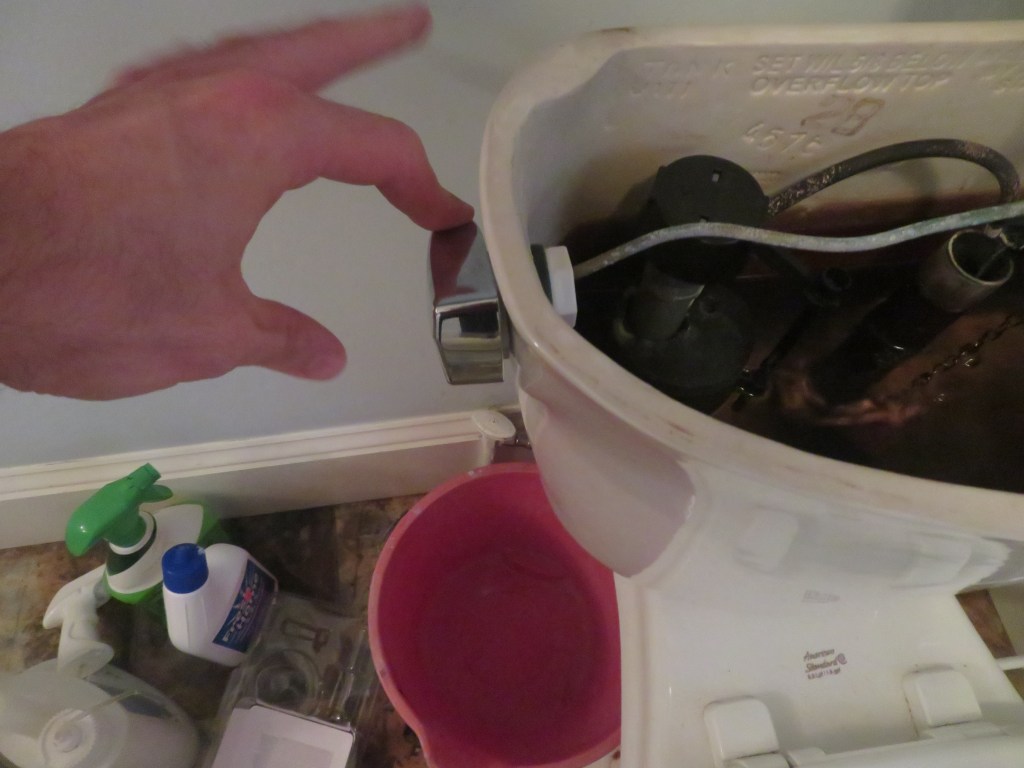
Place a bucket underneath the spot where the valve is connected.
FLUSH the toilet to drain water out of the tank.
You’re left with a mostly-empty tank. This will get fully drained on account of the bucket.
Unscrew the grey piece FIRST.
Now the white nut gets unscrewed (Good for him).
(Expect water to drain out into the bucket at this point).
And the old valve comes out easily enough with that step complete.
Next, remove the clip from the lever hole.
The flapper comes off next. You’ll have to unclip it from the hinges on the overflow cylinder.
It’s pretty nasty. This thing was probably over ten years old.
Ahh, the fresh flapper in connected, easily snapping into the hinge piece.
Add the rubber washer to the new flush valve, screwing in so the ring part is pointing down. This will go into the lower tank hole.
One side of the tubing goes into the tower nozzle.
The other end into the clip piece.
Things looking a bit clunky now, but a fix will come.
Quick trim plus gets the tube size down, allowing for smooth install. Also note the clip on the opposite side of the cylinder.
Now put the new nut back in place, screwing till it’s tight, but don’t wrench it on.
Water line goes back in place.
Now you can turn the water back on a take a flush!
Culturalism · Federal Government

Those Permissible Lies

The problem with paying attention to the media is that you start to see through their illusions. The “facts,” or “reliable sources,” quickly unravel when more than a casual look is granted, and often the transformation is so rapid as to make it feel intentional.  Almost as if they want the plebe to find out, but expect him to have no curiosity.

In point, I recently got a letter from The Center For Voter Information, an activist group purporting to support more engagement by the electorate in state and federal elections. The included paperwork listed my voting score, something I had never heard of, and a rather unnerving idea at that. Luckily I was better than average, so perhaps Mama Kamala will grant me a prize for this achievement. Also included was an application pre-populated with my personal information for a mail-in ballot, a pleasant advantage for those terrified for the Corona.

Since the sender seemed rather official, I did a Google search and discovered it exists as the sister organization to the Voter Participation Center, with both being billed under the joyous and comfortable descriptor of non-partisan. Hearing those words excited my idealistic side. Could it be that a group was simply acting in the public interest, and not shilling for any specific political entity? What a breath of fresh air!

Feeling greatly empowered, I checked the “About Us” page, and read with interest into the biography blurbs. Who could these wonderful folks be, taking time out of their ideological lives to support the common good without a hint of bias? Well, their names are Page Gardner and Tom Lopach, the latter of whom could probably sub for Pete Buttigieg if he desired. Their smiles felt endearing and true, so I decided to perform a bit of a Google search on both.

The results were interesting, to say the least. As it turns out, Page Gardner is actually a long-time Democratic operative with close ties to the Clinton Organized Crime Family and Media Matters. One of her related groups, Women’s Voices Women Vote, even got started using the influence of John Podesta, the former Clinton chief of staff. But don’t worry, because she’s running a “non-partisan” group to promote democracy.

Lopach is not much better. His LinkedIn profile reveals recent jobs promoting Steve Bullock for president, along with earlier roles working for the Democratic Senatorial Campaign Committee and the Committee for a Democratic Majority. Maybe he is unbiased though, just like Snopes claims to be.  One just has to believe.

Groups such as the CFVI are a great example of the tolerated lies in our society. Just like how wearing a white coat makes the speaker legitimate, or holding a PhD is supposed to arrest all doubts. We are trained to focus on the trigger word or image, not what who else (or how much money) might lie behind it. This implied ignorance works because large swaths of the public simply are not curious enough to question what they see, and merely act on the superficial qualities.

Considering how crucial a national election is for the purposes of appointment powers and control of the Justice Department, that obliviousness matters.

Federal Government

Expect a Ceremonial President

Nowadays calling an election with any degree of certainty veers dangerously close to the path of damnation. Copious statistics and technical analysis cannot reliably affirm an outcome in cases where the political Black Swan prevails, and therefore electing to make bold predictions presents a troublesome risk. With that being said, value can still be extracted from pontifications about what specific results might look like.

On this front, let us consider the notion of a Biden Presidency, and how minimally Biden would tend to influence day-by-day machinations. It is abundantly clear that Mr. Robinette has been affected by some form of mental decline. This fact is not advanced to mock him as a person—and indeed sympathy should be called for—but in terms of the office itself, Uncle Joe is bound to be more of a figurehead than any other president beforehand, and perhaps will not even be much apart from a statue to promote the vague sense of national unity.

Such a development is interesting in light of America’s political tradition. Although officially a presidential system, the Executive Branch has vacillated widely in terms of overall power. We have the concept of the Imperial Presidency conceived in the 1970s, and the tenure of Chief of Staff Don Regan, who was popularly seen as “prime minister” over President Reagan’s government. More recently, Dick Cheney usurped great power from George W. Bush while serving as the latter’s vice president, while Donald Trump has reclaimed significant authority for himself in the Oval Office.

But Biden would likely be different. At the tender young age of 78 and with failing memory, he is liable to embody the ceremonial, Head of State-style president visible in most European democracies; typically an elderly man or woman with basic duties to make appointments and appear at events but otherwise divorced from real responsibility and power. Democrats can flash his smile for the cameras, get legislation signed, and then allow the inner chamber doors to shut securely, locking Joey out of the real decision table.

Some will undoubtedly decry the possibility, perhaps appealing to his many years as a senator and champion for transforming bills into law. The same could of course be said for Robert Byrd, who hung on until the very end despite limited abilities towards that junction. Biden’s advantage over others here would be his legacy as a president, not simply another grouchy curmudgeon in the congressional retirement home. That prize is quite substantial for a person not confident of what his own name is.

But fear not, for while Biden may happily inhabit the world of ceremonial statesmanship, the Head of Government will be faithfully executed by a steady puppet mistress, if not her crafty friend.       

Culturalism · Federal Government

On Calls For An Ebony Republic

It has come to my attention that members of the protest collective are now calling for the establishment of their own nation within the existing territory of the continental United States. They appear to want either Texas, or the creation of a new state somewhere in the African continent. While this proposal is hardly novel in nature, it seems like a worthy topic of discussion due to the tide of current affairs.

At the heart of the concept is an obsession with justice. Since blacks were enslaved by various African empires in their home countries and then sold to Europeans wishing to cultivate the New World, they have borne the weight of that legacy for years, and even after the abolishment of slavery through laws such as Jim Crow. Black Nationalists seem to believe the possibility of reform is either unlikely or insufficient, thus separation has become the most viable solution in their eyes; only by ruling an independent country can the past truly be brushed aside so progress rises.

In all honesty, I am not diametrically opposed to the idea for those who want it. The suggestion of Texas seems out of step with history and remains a political non-starter, but perhaps an area of the coastal South could work admirably towards the goal. Having access to the ocean would be important for trade and economic development, as well as travel purposes. It also melds with African-American history, so the foundational possibilities are vivid.

Obviously the obstacles to such a proposal are numerous. To start, the government would have to figure out how to compensate those being forced from their homes or properties, assuming they are not allowed to remain under the new state. Similar questions might abound in terms of federal welfare programs and educational funding—would the existing federal authorities transmit payments for years to the new country, and what might become of American citizenship for those in the new state? The status of security forces in such a regime would be similarly questionable, as National Guardsmen are ultimately dependent on federal money.

 At the same time, benefits might materialize with black Americans being able to command their own destiny politically and economically. Though it is guaranteed that whites would still be blamed for any possible woes of the Ebony Republic, the level of social tension over the question might be exceptionally diminished, perhaps preventing violence or misunderstandings, at least assuming that a large portion of the population would join the country. Over time, one can merely speculate as to the new national outcomes.

So while I’m hardly an advocate of separatism or Black Power, the notion is interesting.

Culturalism · Federal Government

In The Name of The King

A recent inductee to my reading convent was Prussianism and Socialism by Oswald Spengler. The German philosopher is often cited by modern conservatives decrying the West’s decline, particularly in the face of radical Islam, yet they conveniently leave another part out: his harsh criticism of liberalism and a full-throated advocacy for the monarchical system. Given my own skepticism of kingship, I was pleased to read his compelling argument in favor such a model. According to Spengler:

“The leadership of such a system cannot be ‘republican’ Putting aside all illusions, ‘republic’ means today the corruptibility if executive power by private capital. A prince will obey the tradition of his house and the philosophy of his calling. No matter what our opinion of this may be, it removes him from the special political interest of parties as we have them now. He acts as their arbitrator. And, if in a socialistically structured state, membership of the professional councils including the State Council itself is determined in view of practical talents, the prince can narrow the selection by use of ethical and moral criteria. A president, prime minister, or popular representative is the pawn of a party, and a party is in turn a pawn of those who pay for it. The prince is today a government’s only protection against big business. The power of private capital is forcing a unification of socialist and monarchist principles. The individualistic ideal of private property means subjugation of the state by free economic powers, i.e., democracy, i.e., corruptibility of the government by private wealth. In a modem democracy the leaders of the masses find themselves in opposition, not to the capitalists but to money and the anonymous power it exerts. The question is how many of these leaders can resist such power.”

This perspective undoubtedly holds currency among American thinkers today. No matter how hard the grassroots activists work to express their varied aspirations for change, the political tide of complacency remains, driven eternally by money, and the elections dependent upon it. The dynamic helps us understand why Trump’s agenda was largely untouched by the Senate majority, and Bernie fans saw the party shift safely back into the corporate column on both sides of the ticket. The peso wins again.

Spengler’s idea is of course not new. Plato specifically designed his Republic in response to the shortcomings of Greek democracy, creating three classes to administer various aspects of society. At the top were the Guardians, who placed the highest value on knowledge and truth, including the famed “philosopher king.” The state system was protected by the Auxiliaries class, or warriors and soldiers devoted to courage, honor, and homeland (nation). Finally, there stood the Producers, a business classes devoted to the fruit of their labors and material gain.

The model of Plato works to ensure those who love money are deprived from holding the reins of power due to their underlying nature. While the private sector may excel at creating products and generating wealth, it rarely observes standards of virtue, and certainly does not respect the ethical role of the state. Corporations frequently pollute, attempt to diminish worker rights, and undermine the national identity through policies of free movement. They care little of traditions or family, because items can be marketed to anyone with money to pay and a heart to lust.

What remains to be seen is how long the tender auspices of liberal democracy will be enough to keep the populace content. Regardless of which outcome flies this November, it is likely that the multinational establishment will continue scoring wins at the expense of both the people and the integrity of the federal system.  And obviously any checks on this slide require employment of the popular election model, which freely cooperates with private sector money. The cycle continues.

 That is, unless a coronation occurs.

Culturalism · Federal Government · investing · Personal Finance

Corporations Don’t Want To Compete

The common line in conservative and libertarian circles is that corporations are suffering. All they truly want is to operate in the free market without government intrusion, but the State is a harsh mistress. So they are left to solemnly trudge on, tears at the corners of their eyes, wishing and wondering if someday a change might materialize.

While this remains a touching and heart-plucking image, it simply fails to measure up in the real world. Despite the protests of economic liberals, very few firms (at least the larger ones) actually desire substantial market competition, which can easily cut into their profits and require continuous innovation. They find it far easier to establish a dominant position from where effective opposition can be limited, if not entirely stomped out.

In case skeptical souls raise complaints, let us go directly to the source. Peter Thiel, the brilliant co-founder of PayPal, flat out admitted in his excellent book Zero To One that creating monopolies is the way to get rich. Corporations follow his lead quite dutifully, buying up smaller competitors before things get too large, and lobbying for regulations to help protect themselves against new blood. After all, the more market share one firm controls, the less ability tiny rivals have to threaten margins by offering cheaper products.

With this in mind, the primary beneficiaries of free market economics would be startups and small companies, not the towering juggernauts operating today. Of course the problem does not end there. So long as we operate within the bounds of a system where power can be influenced by corporate money through the Legislative and Executive branches, the lobbying for price controls and regulations shall continue. Thus even a genuinely “lolbertarian” system exalting no regulations would eventually be subverted if the reins of power were democratic (or the national leadership could somehow be groomed by big money).

Indeed, were we to establish a system like the aforementioned one, officials would still have to contend with the question of mergers and acquisitions, moves which themselves can diminish market freedom. The debate would then rise as to whether antitrust laws are an acceptable form of regulation to preserve a less-regulated model. Yet does such a position invalidate the purity of the free market model?

The jury is out with their competing opinions, but Corporate America knows exactly where it wants to be.

Uncategorized

Dear Anonymous Commenter

Go spilt your venom
to all who see
ravaged silence
or bended knees

That once prayed
by mantis ring
where savior souls
aloft did sing

A beauty muttered
voices exchange
but endless bitter
thine odor rains.

To target one
vile twice
whose hearts did naught
but anguish splice.

What lone is bare
past reply sheer
solemn joy
or smoking tear?

Far regale
the mists so strife,
still time on time
why waste your life?  

Culturalism

Are Gay Men Braver Than Straights?

Throughout modern history, gay men have been stereotyped as weak, effeminate, emotional, and inferior to their straight equivalents. The terms “Nancy boy” or “flamboyant” give currency to this image, with gay fellows viewed as essentially male versions of women who over-dramatize things for the sake of attention.  They are abject “queens,” filling a role in society but never quite measuring up to the level of masculinity reserved for the primary orientation, especially those versions who are conservative in nature.

Strangely enough though, reality beckons in a different direction. Across the globe, gay or bisexual men have emerged as a visible challenge to social decline and demographic threats, even as their straight (and usually Christian) equivalents stand idly by. This post is not designed to oversimplify, but at least as far as the political classes are concerned, straight men continue to let down the cause of cultural warfare in favor of big financial interests.

We can commence in Europe and highlight the question of Islam. In Holland, where Islamic migration has created a significant problem for the native population, it was Pim Fortuyn who led the political front in opposition, while straight conservative men played the milquetoast, “promote economic growth” card. Fortuyn, himself a Catholic yet also openly gay, would pay the ultimate price when he was assassinated before elections in 2002.

Moving southeast a bit, we encounter the legacy of Jorge Haider, a bisexual nationalist who led the Freedom Party of Austria and the later Alliance for Austria to great political acclaim, only to be (I suspect targeted) for a premature end in 2008. His most visible successor is “HC” Stratche, an absolute disaster (and possible plant) who destroyed the best chance of the FPO at enacting federal migration policies in years with his petty corruption. The consequence is a coalition government including the Green Party, and overall watered down internal security policy.

Our friends in Japan had their own version of a gay icon in the form of Yukio Mishima, who famously attempted to restore the Imperial Japanese system and died in the process, leaving a beautiful literary legacy behind along with several children. In contrast, the present Japanese nationalist scene is dominated by Shinzo Abe, a neoliberal activist who has never sired a single child. Abe is not all-bad, to be sure, but the stark  separation in approaches is telling.

America’s national scene demonstrates a markedly similar conflict. Those termed as “strong conservatives” include the likes of James Lankford and Mike Lee, both dedicated sell-outs to multinational corporations who care nothing about the nation’s long-term destiny.  Religion and traditional values are at best sleeve badges to attain votes, and little else. In contrast, openly gay journalists like Milo Yiannopoulos have made fools of progressives, while officials such as Richard Grenell do what their straight predecessors were too timid to accomplish, domestically and on the international stage.

Perhaps it comes as a function of the social isolation experienced by gay males steeling their resolve against the world, but the phenomenon is nonetheless intriguing. Married straight men with wives and children frequently prove themselves to be dithering weaklings who will accede to protest groups in a heartbeat simply to appear “tolerant,” even while the same respect is not afforded to individuals who back them. Is this effort due to a feeling that they must “keep the peace,” both economically and on the home front?

I believe so, and the implications are dreadful. It is time for us as straight men to seriously consider which aspect matters more: money, or our national future?

Relations and Dating · Self-Improvement

We Occupy Different Worlds

There is an awful lot of emphasis on “coming together” and “being one tribe” in today’s world, both before and after the death of Coors Light. Companies can’t stop preaching the virtues, politicians are ever-willing to trot out their statements of welcome, and educational leaders do much the same. We are all one, they seem to mutter, and you best believe it.

The only problem is, reality tells a starkly different story. Depending on who we are and where we come from, our perceptions and experiences stand to be radically disparate in nature, regardless of how much propaganda can be hoisted to block out those facts. No serious person is going to argue that the 6’4’’ white man has any realistic identification or solidarity with a 5’2’’ Hispanic guy. Perhaps if they work in the same economic field we might witness some closeness, but each will be reacted to as though they are two entirely separate creatures, based on skin tone and height. Only an exasperated fool would attempt to join them.   

In the field of dating, those differences matter, as we well know. The same could be true of a fit and lipped Latina versus a 250lb “Baby blue eyes” blonde. Is anyone willing to argue that somehow they are on even terms? (This excluding the Alt-Right and minority men who worship skin color). Differences matter, and no one actually believes the aforementioned claptrap unless they have to.

Now some empowered soul will stand and declare, “You’re wrong! It’s a about equality under the law.” Please humor me more. Is a working class person without financial resources liable to be treated the same as a rich fellow who can pay for the fancier esquire? The answer is not in doubt, but citizens are expected to cover their eyes and ears.

Even in the economic realm, disparities translate into divided universes. The college kid whose parents are loaded has far more freedom in terms of extracurricular activities and graduate schools than another specimen forced to pay their own way. I am reminded of the self-righteous classmate who mocked me for having a summer job in university while he took a stipend from the parents for an unpaid internship with the high and mighty. Means lead to starkly opposite ends, at least in the medium term.

As time goes on, this prevailing truth continues to manifest itself in the public square. There is no debate that BMM supporters view the world differently than “Defend the Police” adherents. Certainly Democrats and Republicans have separate views of legitimacy, which raises the deafening cry of what will happen in November 2020, regardless of the outcome.

Will everyone unite, because “We’re all Americans after all”?